
Mileage fraud in Europe: how common is it and how to spot it
Mileage fraud in Europe: how common is it and how to spot it

Written by
I. Constantin

Date released
27.03.2026
Comments
0 so far - be the first!
If you have ever bought a used car in Europe, there is a statistically meaningful chance that the mileage on the odometer was not accurate. Mileage fraud in Europe is one of the most widespread forms of consumer fraud on the continent, affecting an estimated one in three used vehicles sold privately and a significant proportion of dealer sales as well.
This guide gives you the most comprehensive overview available of mileage fraud in Europe in 2026: the statistics, the methods used, the countries most affected, the physical and documentary signs to look for, and the single most effective tool for detecting it before you buy.
How Common Is Mileage Fraud in Europe? The Real Statistics
The Scale of Mileage Fraud in Europe
Real World Reality: 3 to 5 out of every 10 cars
On any major European platform, nearly half of listings are misleading.
How Mileage Fraud in Europe Actually Works
There are three primary methods used in modern European mileage fraud operations:
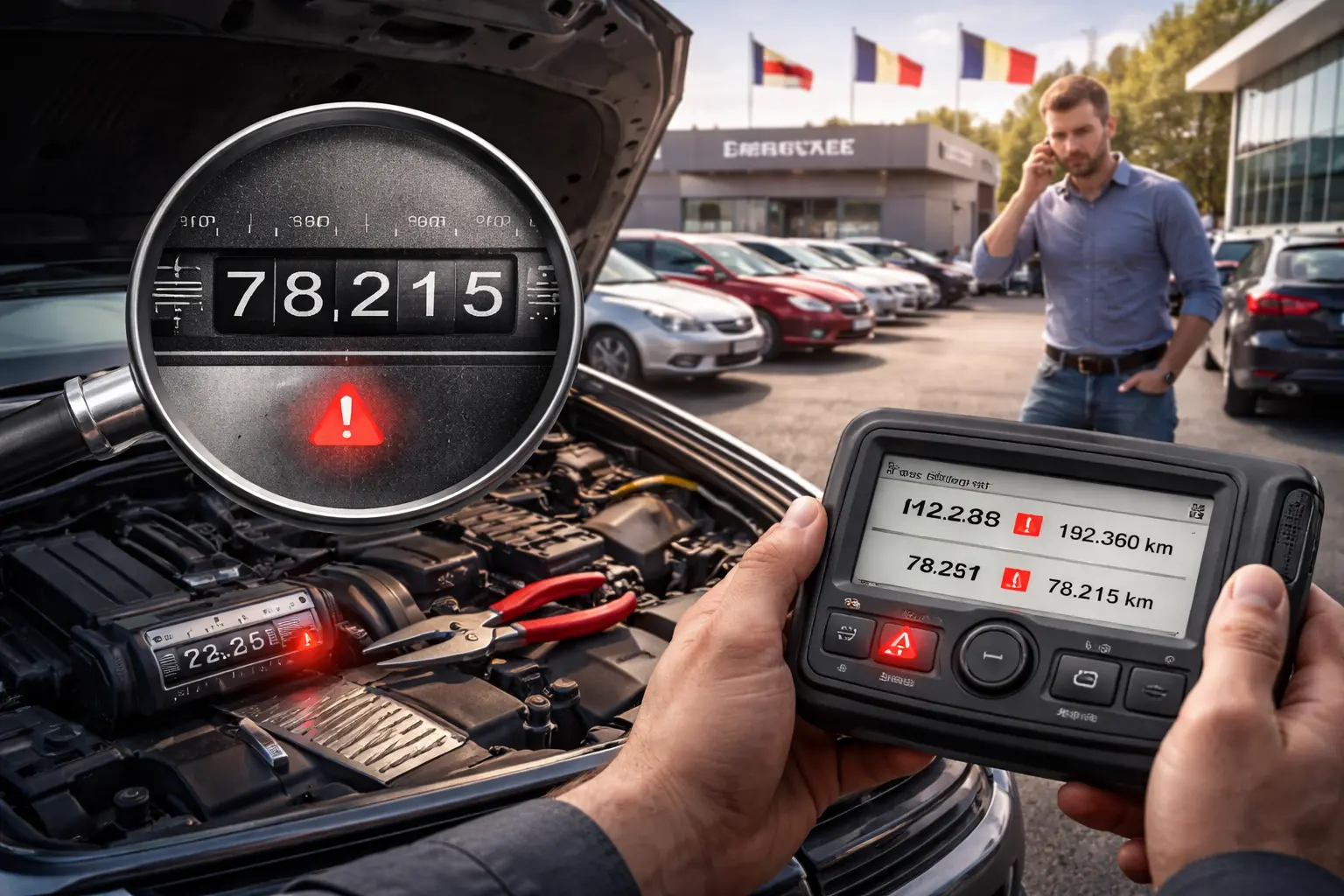
- ECU reprogramming: every modern vehicle stores the odometer reading in the Engine Control Unit (ECU) and several other control modules throughout the car, including the instrument cluster, the airbag module, the ABS module, and in newer vehicles the telematics module. Professional clocking operations use specialist OBD (On-Board Diagnostics) equipment to rewrite the mileage value in each of these modules simultaneously, creating a consistent reading across the vehicle’s electronics.
- Instrument cluster replacement. A damaged or worn instrument cluster is replaced with a unit showing lower mileage, sourced from a salvaged vehicle. This method is less sophisticated and more likely to leave traces, as inconsistencies between the cluster mileage and the mileage stored in other modules can be detected during a professional diagnostic check.
- Registration washing: the vehicle is exported to a country where a new registration creates a fresh administrative history. The odometer is then manipulated at the point of re-export, and the vehicle is sold in a third country with only the brief, clean registration history from the intermediary country visible to the buyer.
Countries Most Affected by Mileage Fraud in Europe
Mileage fraud in Europe is not evenly distributed across the continent. Certain national markets have significantly higher rates of odometer manipulation than others, and understanding the geographic pattern helps buyers assess risk more accurately.
The countries with the highest reported rates of mileage fraud in Europe, based on carVertical data and national consumer protection authority reports, are:
National Market Risk Profiles
Western European markets including France, Belgium, the Netherlands, and Sweden have lower domestic rates of mileage fraud in Europe, but buyers in these markets are frequently exposed to it through imported vehicles from Eastern Europe.
Physical Signs of Mileage Fraud in Europe
While a VIN history report is the most reliable detection method for mileage fraud in Europe, physical inspection remains a valuable first filter. The following physical indicators suggest the vehicle’s true mileage is higher than the odometer shows:
Steering wheel wear: The steering wheel contact surfaces, particularly at the nine and three o’clock positions, wear at a rate directly proportional to use. A vehicle showing 60,000 km should have a steering wheel that shows only light wear. Visible smoothing of the leather or plastic, cracking, or worn-through sections indicate a mileage of 120,000 km or more.
Seat bolster compression: The driver’s seat bolster, the raised section on the outer edge of the seat that you press against when entering, compresses and wears over time. On a genuinely low-mileage vehicle it will be firm and retain its original shape. On a high-mileage vehicle it will be noticeably compressed, sometimes visibly distorted. This is one of the most reliable physical indicators of true mileage.
Pedal rubber condition: The brake, clutch, and accelerator pedal rubbers wear in a very consistent pattern relative to actual use. A vehicle with genuine low mileage will have pedal rubbers with crisp edges and visible moulded patterns. A high-mileage vehicle will have smooth, sometimes cracked or worn-through centres. Note that some sellers replace pedal rubbers before sale, which is itself a red flag.
Door sill and entry scuff marks: The driver’s door sill accumulates scuff marks from shoes at a rate directly proportional to how many times the vehicle has been entered and exited. On a genuinely low-mileage vehicle the sill will show minimal marks. Heavy scuffing on a supposedly low-mileage vehicle indicates the true use is much higher.
Engine bay grime and component age: A high-mileage engine bay will show grime accumulation in difficult-to-reach areas, aged and slightly perished rubber hoses and seals, and general patina consistent with extended use. A freshly detailed or pressure-washed engine bay on an otherwise tired vehicle warrants closer scrutiny.
Tyre age and replacement history: Check the manufacturing date code on all four tyres (a four-digit code on the sidewall showing the week and year of manufacture, e.g. 2319 means the 23rd week of 2019). A vehicle with genuine low mileage should still be on original or first-replacement tyres. Multiple sets of relatively recent tyres on a supposedly low-mileage vehicle suggest the actual mileage is much higher.
Mileage fraud by country — 2026 data
Documentary Signs of Mileage Fraud in Europe
Physical inspection alone is insufficient to reliably detect mileage fraud in Europe, particularly from a professional operation. Documentary analysis provides a second, independent layer of evidence:
Service history mileage progression: Go through the service book and plot the mileage at each stamp against the date of service. The progression should be consistent with normal use, typically 10,000 to 25,000 km per year for a primary vehicle. Look for implausibly low intervals between services, large unexplained gaps in the history, or a sudden change in the mileage rate that does not correspond to any change in the vehicle’s reported use.
Technical inspection records: In most EU countries, the mileage is recorded at every periodic technical inspection (controle technique in France, TUV or DEKRA in Germany, APK in the Netherlands, MOT in the UK). Comparing the mileage at successive inspections against the current odometer reading is one of the most reliable documentary checks for mileage fraud in Europe. A drop in recorded mileage between inspections is definitive evidence of manipulation.
Consistency between documents: The mileage recorded on service stamps, technical inspection certificates, and any recorded repairs should all be consistent with each other and with the current odometer reading. Discrepancies between different documentary sources are a strong indicator of mileage fraud.
Previous registration documents: If the seller has registration documents from a previous country, compare the mileage recorded on those documents against the current odometer. A vehicle imported from Germany with 160,000 km on its Fahrzeugschein that is now showing 85,000 km has clearly been manipulated between its German deregistration and its current listing.
How a VIN Report Detects Mileage Fraud in Europe
A professional VIN history report is the most reliable and comprehensive tool available for detecting mileage fraud in Europe, and it works by doing something no physical inspection or single-country document check can achieve: it queries mileage records from multiple countries and databases simultaneously, creating a complete timeline of every recorded mileage reading throughout the vehicle’s life.
The carVertical report available here covers more than 30 European countries and draws on insurance records, leasing company databases, national inspection authority records, fleet management systems, and manufacturer warranty records. Any mileage reading ever recorded against the vehicle’s VIN will appear immediately in the timeline.
What to Do If You Discover Mileage Fraud After Buying
If you have already purchased a vehicle and subsequently discover evidence of mileage fraud in Europe, your legal options depend on the country where the purchase took place and whether the sale was through a registered dealer or a private individual.
For dealer purchases, most EU countries provide strong consumer protection under the EU Sale of Goods Directive and its national implementations. A vehicle sold with a materially misrepresented mileage constitutes a defective product or a fraudulent misrepresentation, and you are typically entitled to a price reduction, repair, or in some cases a full refund, depending on how much time has elapsed since the purchase.
Contact the dealer in writing, documenting the discrepancy between the stated mileage and the evidence from the VIN report, and request a remedy.
For private purchases, if the seller made specific oral or written representations about the mileage that you can document, you may have a civil fraud claim. But, pursuing it through the courts is time-consuming and expensive relative to the amount at stake for most used car purchases.
The practical lesson is that legal recourse after the fact is far less effective than prevention before the purchase. A 19.99 euro VIN report run before you sign anything is the most reliable and most affordable protection against the consequences of mileage fraud in Europe.
Frequently Asked Questions
Can I detect mileage fraud in Europe just from a physical inspection?
What is the most effective way to detect mileage fraud?
Which countries have the highest rates of mileage fraud?
Is mileage fraud in Europe illegal?
Does a recent technical inspection prove the mileage is genuine?
The Bottom Line
Mileage fraud in Europe is more prevalent, more sophisticated, and more financially damaging than the majority of used car buyers appreciate. Between 30 and 50 percent of privately sold used cars across the continent have had their odometers manipulated at some point, digital technology has made that manipulation easier than ever, and the cross-border structure of the European used car market makes it invisible to buyers who do not use multi-country history verification tools.
The good news is that detecting mileage fraud in Europe has never been easier or more affordable for buyers who take the right steps. A VIN history report, powered by carVertical and covering more than 30 European countries, costs 19.99 euros and takes minutes to receive. It is the single most effective tool available for verifying that the mileage on any used car you are considering is genuine. Combined with a thorough physical inspection and a review of all available documentation, it gives you comprehensive protection against the most widespread form of fraud in the European used car market.
Other posts you might like


Want a fast & cheap COC? Find yours now!
