

Written by
I. Constantin

Date released
18.03.2026
Comments
0 so far - be the first!
history check on a used car, you’ve almost certainly been asked for your VIN number. But what exactly is a VIN, why does it matter, and where do you find it on your vehicle?
This guide answers all of those questions and explains why your VIN is the single most important piece of information when ordering official vehicle documents like a COC.
VIN stands for Vehicle Identification Number. It is a unique 17-character code assigned to every motor vehicle at the time of manufacture. No two vehicles in the world share the same VIN, it is the automotive equivalent of a fingerprint.
The VIN was standardized internationally in 1981 under ISO 3779, which means the format is consistent across all manufacturers and all countries. Whether you’re driving a BMW manufactured in Germany, a Toyota built in Japan, or a Ford assembled in the United States, your vehicle’s VIN will always follow the same 17-character structure.
A VIN is always exactly 17 characters long and uses a combination of capital letters and numbers. The letter O, I, and Q are never used in a VIN to avoid confusion with the numbers 0, 1, and 9.
Here is an example of a BMW VIN:
WBA3A5C50DF354762 |
Every section of that code has a specific meaning:
Characters | Section | What It Tells You |
1–3 | WMI | World Manufacturer Identifier — country and manufacturer (e.g. WBA = BMW Germany) |
4–9 | VDS | Vehicle Descriptor Section — model, engine type, body style, restraint systems |
10–17 | VIS | Vehicle Identifier Section — model year, plant, and unique serial number |
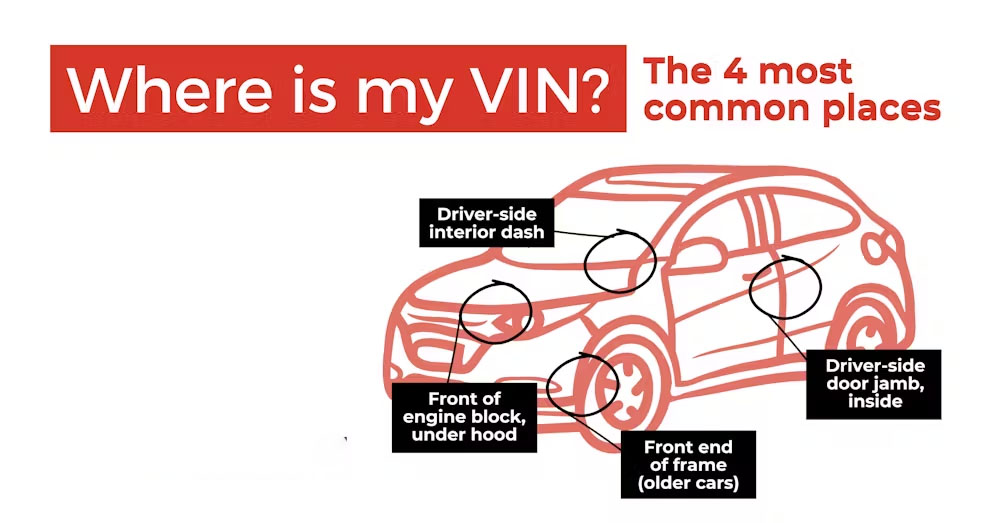
Your VIN appears in several locations on your vehicle and in your documentation. Here are the most common places to look:
The most accessible location is on the dashboard, visible through the windscreen on the driver’s side. Look at the lower corner of the windshield — you should see a small plate with the 17-character VIN code. You can read it from outside the vehicle without opening the door.
Open the driver’s door and look at the metal pillar between the front and rear doors (the B-pillar). There is usually a sticker or stamped plate here containing the VIN, along with other vehicle data like paint code and gross weight.
On most vehicles, the VIN is also stamped directly onto the engine block or on a plate attached to the front of the engine bay. This location is often used by mechanics and inspectors during technical checks.
Your official registration document (known as a logbook, carte grise, Fahrzeugbrief, or kentekenbewijs depending on your country) always contains the VIN. It appears in field E of the EU-standardised registration certificate.
Your vehicle insurance policy will also list the VIN, usually in the vehicle description section.
If your vehicle came with a Certificate of Conformity from the previous owner or from the dealership, the VIN is printed on the first page of that document.
When registering a vehicle in any EU country — whether you imported it from another member state or are re-registering after a change of ownership — the registration authority will use your VIN to verify the vehicle’s identity and technical specifications.
The VIN is specifically required to:
Without a valid 17-character VIN, no COC can be issued — and without a COC, vehicle registration in most EU countries is impossible or significantly delayed.
Yes. The first three characters of any VIN identify the manufacturer and country of origin. Here are some of the most common manufacturer codes you’ll encounter in Europe:
WMI Code | Manufacturer | Country |
WBA, WBS, WBX | BMW | Germany |
WDD, WDB | Mercedes-Benz | Germany |
WAU, AAA, TRU | Audi | Germany |
WVW, WV1 | Volkswagen | Germany |
VF1, VF3, VF6 | Renault | France |
VF7, VF8 | Citroën / Peugeot | France |
ZAR, ZFA | Alfa Romeo / Fiat | Italy |
SCC, SAJ | Jaguar / Land Rover | United Kingdom |
YV1, YV2 | Volvo | Sweden |
TMB | Škoda | Czech Republic |
When entering your VIN to order a Certificate of Conformity or run a vehicle check, small errors can cause significant delays. Here are the most common mistakes:
Before placing an order for a Certificate of Conformity, it is always worth verifying your VIN to make sure the vehicle data is clean and matches your documents. A VIN check can reveal:
At Auto-COC.eu, we offer a free VIN verification tool that lets you confirm your vehicle’s identity before you order your COC — helping you avoid rejected applications and wasted time.
Official, manufacturer-issued certificates for 90+ brands.
Express delivery available — PDF sent immediately upon processing.
Browse All COCs →When you order a Certificate of Conformity through Auto-COC.eu, your VIN is the key piece of information we use to request the correct document from the manufacturer or their authorized EU representative.
The COC we obtain is specific to your vehicle — it contains your exact VIN, your vehicle’s production specifications, its EU type approval number, and its emission classification. This is why the VIN must be entered correctly: the manufacturer’s database uses it to locate your vehicle’s exact record and generate the corresponding document.
Important: We require all VIN numbers to be exactly 17 characters. If your vehicle was manufactured before 1981, it may have a shorter identification number — in this case, please contact our support team before placing an order.
For most people ordering a COC through Auto-COC.eu, the realistic total timeline from order to physical document in hand is 5–8 business days for standard delivery, or 4–6 business days with express. If you need to begin registration before the physical document arrives, the digital PDF sent upon processing gives you a head start.
The two things most within your control are: getting the VIN right first time, and choosing express delivery if timing is at all tight. Everything else is largely determined by the vehicle manufacturer — and Auto-COC.eu handles that part for you.
Enter your VIN, select your brand, and choose standard or express delivery.
Best price guaranteed · EU-compliant · Multilingual support


