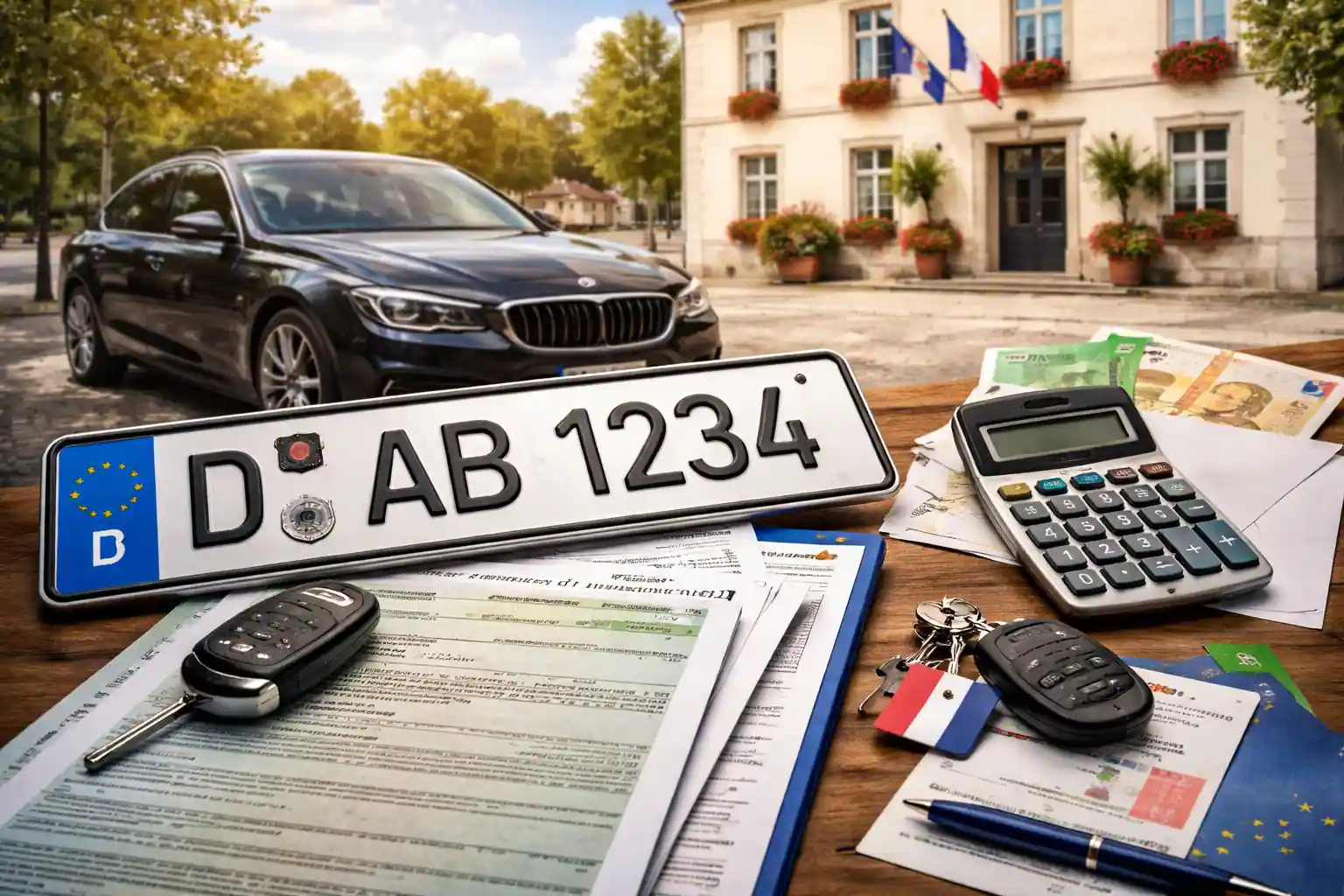
How to Register a German Car in France – Complete 2026 Guide

Written by

I. Constantin

Date released

18.03.2026

Comments

0 so far - be the first!

If you recently bought a vehicle in Germany and are now living in France – or if you’ve moved to France and brought your German-registered car with you, you will need to register a German car in France to comply with French law. 

This guide walks you through everything you need to know to register a German car in France in 2026, from gathering the required documents to understanding the role of the COC, calculating the costs involved, and submitting your application through the ANTS portal. Whether you bought a BMW, Mercedes, Volkswagen, or Audi in Germany, the process is the same.

🚗 Need a COC to Register Your German Car in France?

Auto-COC.eu provides official, manufacturer-issued Certificates of Conformity for 90+ brands.

Best price online · Free EU delivery · PDF copy included as standard

About Auto-COC.eu: We provide authentic, manufacturer-issued Certificates of Conformity for over 90 vehicle brands across Europe. All COCs are fully EU-compliant and accepted by registration authorities across all EU member states. For a specific estimate, contact our support team at office@auto-coc.eu.

Why Do You Need to Register a German Car in France?

French law requires that any vehicle driven on French roads be registered with a French carte grise (certificat d’immatriculation) if the owner has been a resident of France for more than six months. If you have imported a German car – whether purchased privately, through a dealer, or brought with you when relocating, you are legally required to register a German car in France within that timeframe. Continuing to drive on German plates after this deadline can result in fines and difficulties with insurance.

There is also a practical reason: French insurance companies require a French registration number to insure your vehicle properly. 

Without a carte grise, you cannot get full French insurance coverage, you cannot legally sell the vehicle in France, and you may face complications at technical inspection (contrôle technique). The sooner you start the process of registering your German car in France, the fewer complications you will encounter.

How Long Can You Drive on German Plates in France?

If you are a French resident who has purchased a vehicle in Germany, you have one month from the date of purchase to register it in France. If you are relocating to France from Germany and bringing your car with you, you have six months from the date you establish French residency to complete the registration. These deadlines are strictly enforced, and driving beyond them exposes you to a fine of up to €750 under French traffic law.

There is one exception: if you are in France temporarily (for example, as a tourist or on a short work assignment), you may drive on foreign plates for the duration of your stay. 

But once you take up permanent or long-term residence, the clock starts. Many people underestimate how quickly six months passes when dealing with relocation paperwork, so it is advisable to begin the process of registering your German car in France as soon as you have your French address established.

The Certificate of Conformity (COC) — The Most Important Document

The single most important document you will need to register a German car in France is the Certificate of Conformity, known in French as the Certificat de Conformité Européen (CCE) or simply the COC. This is an official document issued by the vehicle manufacturer that confirms your car meets all applicable EU technical, safety, and environmental standards. Without it, the French registration authority (ANTS) cannot process your application.

The COC contains your vehicle’s full technical specifications: the VIN number, engine type, emission class (Euro 5 or Euro 6), CO₂ emissions, dimensions, maximum weight, and the EU type approval number. French authorities use this data to determine the applicable taxes,  and to confirm that the vehicle is legally admissible for use on French roads. 

If you do not have your original COC, you can order an official replacement through Auto-COC.eu for all major German brands including BMW, Mercedes, Volkswagen, Audi, and Porsche.

Full List of Documents Required to Register a German Car in France

To successfully register a German car in France, you will need to gather the following documents before submitting your application. Missing even one of them will cause your application to be rejected by ANTS, so prepare everything in advance:

  • Certificate of Conformity (COC) — official manufacturer-issued document (required)
  • German Fahrzeugbrief (Zulassungsbescheinigung Teil II) — the original German vehicle title document
  • German Fahrzeugschein (Zulassungsbescheinigung Teil I) — the German registration certificate
  • Proof of French residence — utility bill, rent receipt, or attestation from your employer dated within 6 months
  • Valid photo ID — French residence permit, passport, or national identity card
  • Completed application form Cerfa 13750*07 — available on the ANTS website
  • Proof of valid technical inspection (contrôle technique) — required if the vehicle is more than 4 years old
  • Proof of insurance — French insurance certificate covering the vehicle
  • Payment for registration fees — varies by region and CO₂ emissions (see costs section below)


If your vehicle is financed and the lender holds the title (Fahrzeugbrief), you will need a letter from the lender authorizing the registration transfer. This is a common situation for vehicles purchased on credit in Germany.

What is the ANTS Portal and How Does It Work?

Since 2017, all vehicle registration requests in France must be submitted online through the ANTS portal (Agence Nationale des Titres Sécurisés). There are no longer physical prefecture offices handling registration in person – everything is done digitally. You will need a France Connect or ANTS account to log in, upload your documents, and pay the registration fees online.

Once you submit your application to register a German car in France through ANTS, the system will verify your documents and generate a temporary registration certificate (certificat provisoire d’immatriculation/CPI) that allows you to drive legally while your physical carte grise is produced and mailed to your address. 

The CPI is valid for one month. The physical card typically arrives within 5 to 15 working days. If there are problems with your application (most commonly a missing COC or incorrect technical data), ANTS will reject the submission and you will need to resubmit with the correct documents.

Step-by-Step Process to Register a German Car in France

Here is the complete process to register a German car in France in 2026, in the order you should follow it:

01
Certificate of Conformity

Obtain your COC if you do not already have it. Order from Auto-COC.eu if the original is missing.

02
Contrôle Technique

Get a technical inspection if the vehicle is more than 4 years old at a certified center in France.

03
French Insurance

Take out French insurance on the vehicle. You need this before submitting the application.

04
ANTS Account

Create an account on ants.gouv.fr using France Connect or your French tax number.

05
Online Application

Complete and submit the application online, uploading all required documents as PDF scans.

06
Registration Fees

Pay the fees online by card. Costs vary by region and CO₂ output.

07
Print CPI

Print your CPI (temporary certificate) immediately. This is your legal authorization to drive.

08
Wait for Carte Grise

Wait for the original document to arrive by post (typically 5–15 working days).

09
New Plates

Attach your new French registration plates once you receive the carte grise.

🏁 Process Completed!

How Much Does It Cost to Register a German Car in France?

The cost to register a German car in France depends on several factors including the region (département) where you live, the vehicle’s CO₂ emissions, its fiscal horsepower (CV fiscaux), and whether a malus écologique applies. 

Here is a breakdown of the typical costs involved:

Cost Item

Estimated Amount

Regional tax (taxe régionale)

€27–€60 per CV fiscal — varies by region

National management fee

€11 (fixed)

CO₂ malus écologique

€0 to €50,000+ depending on emissions

Certificate of Conformity (if missing)

€50–€315 depending on brand

Contrôle technique (if required)

€60–€80 at a certified center

Carte grise card fee

€2.76 (fixed)

The malus écologique is the most variable and potentially most expensive part of registering a German car in France. Vehicles with CO₂ emissions above 123 g/km are subject to this tax, which increases steeply for higher-emitting vehicles. A large German SUV or sports car with emissions above 200 g/km can attract a malus of several thousand euros. You can calculate your malus in advance using the official French government simulator at service-public.fr.


💡 Tip — Check Your CO₂ Before You Buy

If you are buying a German car with the intention of registering it in France, always check the CO₂ figure on the COC before completing the purchase.

A vehicle showing 150 g/km on its COC will attract a significantly lower malus than one showing 180 g/km — even if they appear identical.

The CO₂ figure is in box V.7 of the Certificate of Conformity.

A vehicle showing 150 g/km on its COC will attract a significantly lower malus than one showing 180 g/km — even if they appear identical.

The CO₂ figure is in box V.7 of the Certificate of Conformity.

The Malus Écologique — What German Car Owners Need to Know

The malus écologique (also called taxe sur les véhicules polluants) is a CO₂-based penalty tax applied when registering a vehicle in France for the first time. It applies to all vehicles, and is calculated based on the CO₂ emissions figure shown on the vehicle’s Certificate of Conformity. For vehicles registered in France for the first time in 2026, the malus threshold starts at 118 g/km of CO₂.

For German cars, this is particularly important because many popular German models – especially diesel-powered SUVs, estates, and saloons – have CO₂ figures that trigger the malus. A BMW X5 xDrive40d, for example, emits around 195 g/km under WLTP testing, which would attract a malus of approximately €7,000 in 2026. A Volkswagen Golf 2.0 TDI, by contrast, emits around 115–130 g/km — potentially just above or below the threshold depending on the exact variant.

This is why the COC is so important: the exact CO₂ figure on your specific vehicle’s document is what determines your malus, not a general estimate.

Common Mistakes When Registering a German Car in France

The process of registering a German car in France is relatively straightforward if you have all the right documents, but there are several common mistakes that cause applications to be rejected or significantly delayed.

Being aware of them in advance will save you considerable time and frustration:

  • Submitting without a COC — ANTS will automatically reject any application that does not include a valid Certificate of Conformity. This is the most common reason for rejection.
  • Using an unofficial or downloaded COC template — only manufacturer-issued COCs are accepted. Printouts from unofficial sources are rejected.
  • Incorrect VIN entry — a single character error in the VIN will cause a mismatch between the COC and the application. Always double-check against the physical plate on the dashboard.
  • Outdated contrôle technique — the technical inspection must be less than 6 months old at the time of submission (2 years for a newly passed vehicle).
  • Missing the German title document (Fahrzeugbrief Teil II) — many people only bring the registration certificate (Teil I) and forget that both parts are required.
  • Waiting too long — submitting your application after the legal deadline exposes you to fines and may complicate the insurance situation.

Can You Register a German Car in France Without a COC?

Technically, there is an alternative route for vehicles whose COC cannot be obtained: the réception à titre isolé (RTI). This is an individual type approval process carried out by the DREAL (Direction Régionale de l’Environnement, de l’Aménagement et du Logement) where a technical expert physically inspects the vehicle and certifies its compliance with EU standards. However, the RTI is significantly more expensive (typically €300–€800), takes much longer (several weeks to several months), and requires the vehicle to be physically present for inspection.

For the vast majority of people looking to register a German car in France, obtaining the COC through a service like Auto-COC.eu is far faster, less expensive, and less stressful than the RTI route. 

The COC can be ordered online in minutes, the PDF is delivered by email, and the process does not require any physical appointments. The RTI should only be considered as a last resort for very old vehicles, heavily modified vehicles, or cases where the manufacturer can no longer issue a COC.

Order Your COC Today

Official, manufacturer-issued certificates for 90+ brands.

Express delivery available — PDF sent immediately upon processing.

Browse All COCs →

Frequently Asked Questions

Once all documents are in order, you can submit your application online through ANTS in under an hour. The temporary registration certificate (CPI) is issued immediately. The physical carte grise typically arrives within 5 to 15 working days. The most time-consuming part of the process is obtaining the COC if you do not have one — which can take up to 15 business days when ordered through Auto-COC.eu — and completing the contrôle technique if your vehicle is over 4 years old.
Yes. A Certificate of Conformity is mandatory to register a German car in France through the ANTS portal. Without it, your application will be rejected. If you have lost your original COC or never received one, you can order an official replacement for your specific vehicle through Auto-COC.eu. The document is issued by the manufacturer and is accepted by all French registration authorities.
The cost varies depending on your region, the vehicle's fiscal horsepower, and its CO₂ emissions. The base cost includes a regional tax (between €27 and €60 per CV fiscal depending on the département), a fixed national management fee of €11, and a €2.76 card fee. On top of this, a malus écologique applies if CO₂ emissions exceed 118 g/km — this can range from a few hundred euros to over €50,000 for very high-emitting vehicles. A missing COC will add the cost of obtaining one (from €50 for a PDF-only COC up to €315 for some premium brands).
Yes, but you will need a letter from the German lender authorizing the registration transfer to France. This is because the Fahrzeugbrief (vehicle title document) is typically held by the lender when a vehicle is financed. Contact your German bank or finance company and request a written authorization — most lenders are familiar with this process and can provide the letter within a few days. Without this letter, ANTS will not accept the application.
Once you receive your French carte grise, you are legally required to replace your German plates with French plates bearing your new French registration number. You should also return the German plates to the German registration authority (Zulassungsstelle) along with a deregistration form (Abmeldung) to formally cancel the German registration. Some buyers do this at a German embassy or consulate in France. Failure to deregister the vehicle in Germany can result in continued road tax being charged there.
Yes, significantly. Electric vehicles are completely exempt from the malus écologique, as they have zero tailpipe CO₂ emissions. They are also exempt from the regional tax in most French départements, meaning the cost to register a German car in France if it is electric can be as low as €13.76 (management fee + card fee only). This makes registering a German electric vehicle — such as a BMW i4, Mercedes EQC, or Volkswagen ID.4 — substantially cheaper than registering a comparable combustion engine vehicle.

Final Thoughts

The process to register a German car in France is entirely manageable if you approach it systematically. The key is to prepare your documents in the right order: get the COC first, then the contrôle technique, then the insurance, and only then submit through ANTS. Attempting to submit without a complete document set will result in rejection and wasted time.

At Auto-COC.eu, we help thousands of people every year obtain the official Certificate of Conformity they need to complete vehicle registrations across all EU countries. Whether you are registering a BMW, a Mercedes, a Volkswagen, or any other German brand in France, we can provide your COC at the best price online,  with free delivery!

Ready to Order?

Enter your VIN, select your brand, and choose standard or express delivery.

Best price guaranteed · EU-compliant · Multilingual support

About Auto-COC.eu: We provide authentic, manufacturer-issued Certificates of Conformity for over 90 vehicle brands across Europe. All COCs are fully EU-compliant and accepted by registration authorities across all EU member states. Processing times listed in this article are indicative averages based on typical orders and may vary by brand, vehicle age, and order volume. For a specific estimate, contact our support team at office@auto-coc.eu.

Other posts you might like

Want a fast & cheap COC? Find yours now!