
The market for Certificate of Conformity documents has grown rapidly alongside the European used car import industry, and, unfortunately, so has the number of fake COC document cases. Whether you are buying a second-hand vehicle, importing a car from another country, or simply verifying documentation before completing a purchase, knowing how to identify a fake COC document is an essential skill in 2026. A fraudulent document can cost you your vehicle registration, expose you to serious legal liability, and may result in criminal charges.
This guide breaks down every major red flag to look for, explains how to verify a COC document’s authenticity, and shows you how to ensure you always receive a genuine, legally valid certificate – including through trusted services that source every document directly from official manufacturer databases.
As demand for COC documents has surged, a parallel market of fraudulent providers has emerged. These operators typically offer documents at suspiciously low prices (often under EUR 70), exploit buyers’ lack of familiarity with what a genuine COC should look like, and either deliver generic templates or disappear entirely after payment.
The risk is not limited to obvious back-alley scams. Some fake COC document providers operate professional-looking websites, complete with stock photos and fabricated reviews. The only reliable defence is knowing exactly what a genuine COC contains and using verified services that leave no room for doubt.
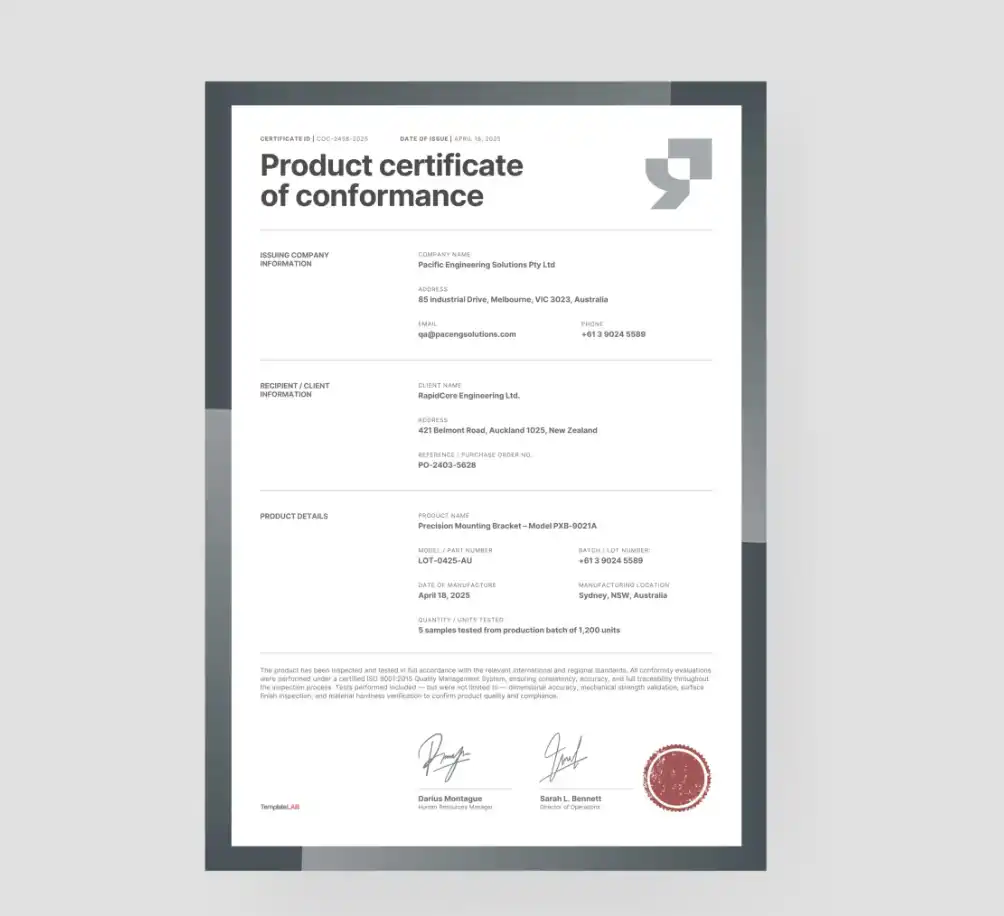
Legitimate COC retrieval requires access to manufacturer databases, which carry real operational costs. Any provider offering a COC for under EUR 70 is almost certainly not accessing official data. A genuine document from a reputable service such as auto-coc.eu starts at EUR 90, already highly competitive. Anything significantly below that threshold should immediately raise suspicion of a fake COC document.
Every authentic COC is tied to a specific vehicle’s unique 17-character VIN. A fake COC document will often contain a generic, incorrect, or entirely absent VIN. Always cross-reference the VIN printed on the COC against the VIN plate on the physical vehicle (typically found on the dashboard visible through the windscreen, on the door jamb, and in the vehicle’s registration card). Any mismatch is grounds to reject the document immediately.
A genuine COC contains precise, vehicle-specific technical data: exact engine displacement, power output in kW, CO2 emissions in g/km, the applicable Euro emissions standard, wheelbase, maximum authorised mass, and the European type-approval number. A fake COC document frequently contains blank fields, approximated figures, or data copied from a different model variant. If any technical field looks incomplete, rounded off, or inconsistent with the vehicle’s known specifications, treat it as a fake COC document until proven otherwise.
One of the most reliable indicators of a fake COC document is the absence of a valid European type-approval number. This alphanumeric code, structured in a specific EU format, links the vehicle to its official homologation record. Fraudulent documents either omit this field entirely or populate it with a plausible-looking but fictitious string of characters. You can verify type-approval numbers against the EU’s official NANDO (New Approach Notified and Designated Organisations) database.
Manufacturer-issued COC documents follow strict official templates that are consistent across all vehicles of the same brand. Genuine BMW, Mercedes-Benz, Volkswagen, and other manufacturer COCs have precise, professional formatting with official logos, consistent typography, and correct field labels. A fake COC document often betrays itself through inconsistent fonts, misaligned fields, low-resolution logos, irregular spacing, or field labels that differ from the standard EU COC template defined in Directive 2007/46/EC and its 2026 successors.
A fake COC document almost always comes from a provider that cannot be independently verified. No company registration number, no physical address, no named contact person, no independent reviews on platforms like Google or Trustpilot. Legitimate providers such as auto-coc.eu are registered businesses with transparent legal identities, verifiable customer feedback, and secure payment infrastructure. If you cannot verify who you are buying from, assume the document may be a fake COC document.
Retrieving a COC for a vehicle manufactured before 2000, or for a rare or low-volume model, requires database research that takes time. Any provider promising delivery in minutes for such vehicles is not actually accessing official records – they are almost certainly generating a fake COC document from a template. Genuine services are honest about delivery timeframes, especially for older vehicles.
Modern COC documents issued through verified services include digital authentication codes, QR references, or other verifiable markers that allow registration authorities to confirm the document’s origin. A fake COC document will lack these authentication elements, or will contain codes that return no result when checked. If the provider cannot explain how their document can be authenticated by a registration authority, that is a definitive red flag.
Presenting a fake COC document to a registration authority — even unknowingly — can result in:
There is no acceptable shortcut. Always verify your COC source before paying.
If you have received a COC and want to confirm it is not a fake COC document, follow these verification steps before presenting it to any authority:
auto-coc.eu sources every Certificate of Conformity directly from official manufacturer databases.
Every document is vehicle-specific, VIN-matched, and accepted by registration authorities across the EU.
Prices start from EUR 115 — with digital delivery in 3–7 business days, or FREE delivery anywhere in the EU within an additional 3-5 business days.
Free VIN check available before you order — no risk, no guesswork.
Trusted by tens of thousands of vehicle owners across Europe in 2026.
Visit: www.auto-coc.eu
A fake COC document is a legal and financial hazard that can derail your vehicle registration, cost you thousands of euros, and in serious cases lead to criminal liability. In 2026, the tools available to fraudsters have improved, but so have the tools available to buyers who know what to look for. Armed with the red flags and verification steps in this guide, you are significantly better protected against document fraud than the average vehicle buyer.
The simplest and most effective protection of all, however, is to always source your COC from a verified, trusted platform. auto-coc.eu delivers authentic, VIN-matched Certificates of Conformity sourced directly from manufacturer databases. When a genuine document is this accessible, there is no reason to take risks with any other provider. Visit www.auto-coc.eu and make sure your COC is the real thing.
Enter your VIN, select your brand, and choose standard or express delivery.
Best price guaranteed · EU-compliant · Multilingual support


