

Written by
I. Constantin

Date released
11.05.2026
Comments
0 so far - be the first!
Buying a used electric vehicle from another EU member state is becoming increasingly common. Lower prices in Germany, Belgium, or the Netherlands attract thousands of buyers every year. But when it comes to registration, EV owners quickly discover that the process is not identical to registering a conventional petrol or diesel car.
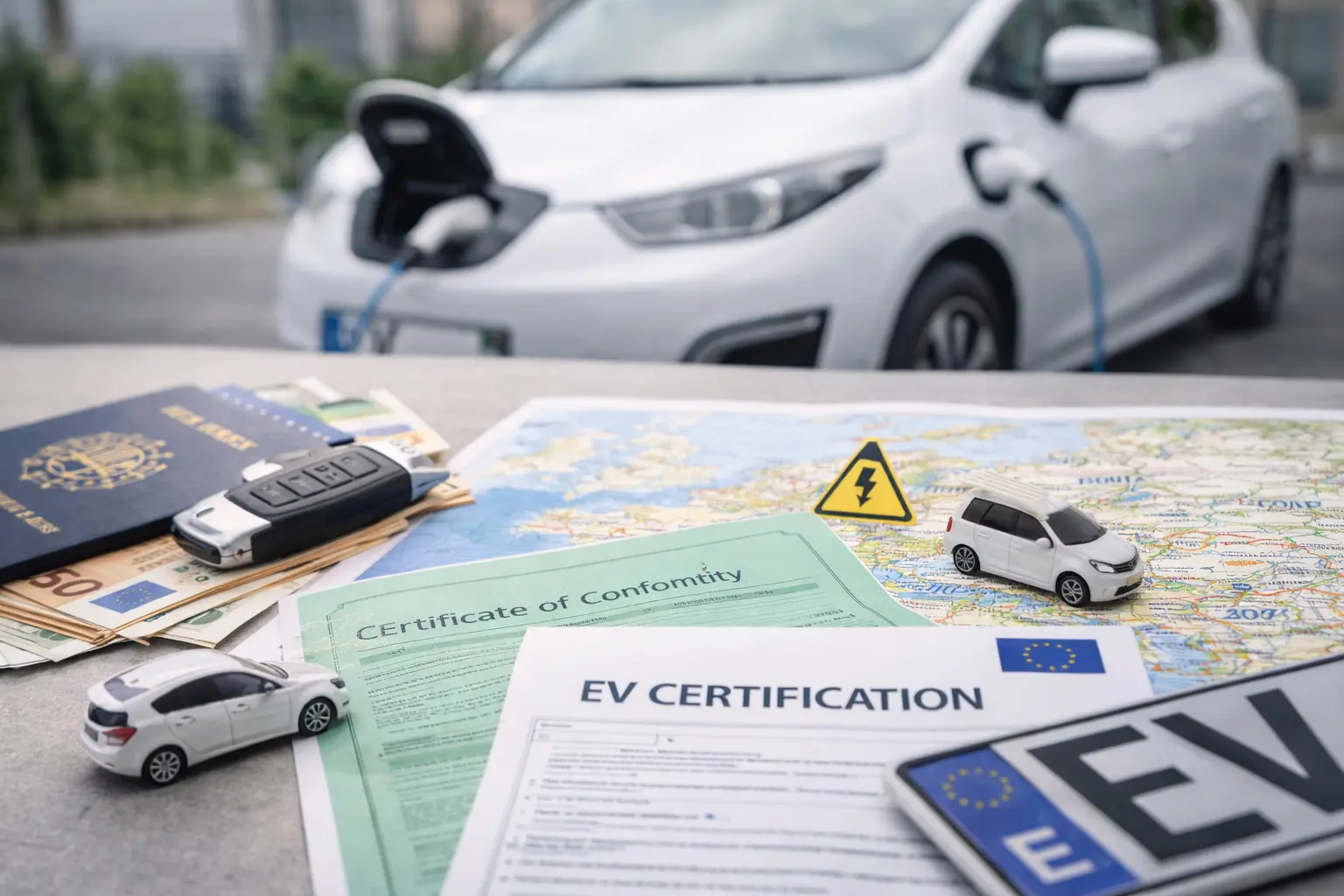
The EV COC – the Certificate of Conformity for electric vehicles – comes with its own set of rules, data fields, and potential complications that are worth understanding before you complete the purchase.
A Certificate of Conformity is the document that proves your vehicle meets all European Union technical and environmental standards. Every car sold legally within the EU must have one. For electric vehicles, the EV COC serves the same fundamental purpose, but it contains additional technical data that reflects the unique nature of battery-powered cars.
Without a valid EV COC, you cannot complete the registration process in your country of residence. National vehicle authorities — such as RAR in Romania, TÜV in Germany, or RDW in the Netherlands — will not issue registration plates until conformity is confirmed. This makes obtaining the correct document a non-negotiable first step.


The structure of the EV COC follows the same EU directive framework as any other COC, but several data fields are specific to electric and plug-in hybrid vehicles. Understanding these differences helps you verify that the document you receive is complete and valid for registration purposes.
The key additional fields you will find on an EV COC include:
If any of these fields are missing or incomplete on your EV COC, the registration authority may reject the document and ask for a reissued version from the manufacturer.
For combustion engine vehicles, the COC retrieval process is relatively straightforward. Most manufacturers have well-established systems for reissuing documents, and dealers are familiar with the procedure. For electric vehicles, however, several factors can complicate things.
First, many popular EV models — Tesla, Rivian, and some newer Chinese-brand vehicles — operate outside traditional dealer networks. This means there is no physical dealership to walk into and request an EV COC. Tesla, for example, handles all documentation requests through its own internal systems, and response times can vary significantly between countries.
Second, software-defined vehicles present a new challenge. Some modern EVs receive over-the-air updates that alter performance parameters, charging behaviour, or range figures. If a significant update occurred after the original EV COCwas issued, authorities may question whether the document still accurately reflects the vehicle’s current technical state.
Third, battery replacements — whether under warranty or after an accident — can raise questions about whether the original EV COC remains valid. A battery swap to a different capacity unit, even within
While the EU harmonises vehicle type approval through shared directives, each member state retains some autonomy over how it processes registrations. This creates practical differences that EV buyers should anticipate.
In countries like Romania, Hungary, and Bulgaria, national vehicle inspection authorities may be less familiar with certain EV brands — particularly newer Chinese manufacturers such as BYD, NIO, or MG. Presenting an EV COC for one of these vehicles may trigger additional verification steps or longer processing times simply because inspectors are encountering the model for the first time.
In contrast, countries with high EV adoption rates — Norway, the Netherlands, and Germany — have streamlined processes for EV COC validation, and registration can sometimes be completed within a single appointment. The lesson is simple: research your target country’s specific requirements before finalising the purchase.
If you are purchasing an electric vehicle from another EU country and the seller cannot provide the original EV COC, you have several options. Contacting the manufacturer directly is the most reliable route, though response times and fees vary. Authorised service centres for the brand can sometimes facilitate the request faster than a cold contact through a general customer service line.
Specialist online platforms that handle COC retrieval — such as auto-coc.eu — can also process EV COC requests for a wide range of makes and models. These services access manufacturer databases directly and can often deliver the document faster than going through a dealer, particularly for brands with limited physical presence in your country of registration.
Official, manufacturer-issued certificates for 90+ brands.
Express delivery available — PDF sent immediately upon processing.
Browse All COCs →Before submitting your EV COC to the registration authority, take a few minutes to verify the following:
A single discrepancy can send you back to square one, delaying registration by weeks.
Registering an electric vehicle across EU borders is entirely achievable, but it demands more preparation than a standard petrol car import. The EV COC carries more technical data, involves manufacturers who sometimes operate outside conventional dealer structures, and plays a direct role in determining your tax position and subsidy eligibility.
The smartest move is to secure the EV COC before completing the purchase — not after. Confirm that the document is available, accurate, and compliant with the requirements of your specific country. If in doubt, specialist services like auto-coc.eu can guide you through the process and help you avoid the delays and costs that catch unprepared buyers off guard.
Enter your VIN, select your brand, and choose standard or express delivery.
Best price guaranteed · EU-compliant · Multilingual support


