


Written by
I. Constantin

Date released
5.53.2026
Comments
0 so far - be the first!
Every year, thousands of car enthusiasts, expats, and importers bring vehicles from Japan and the United States into the European Union. The appeal is clear: access to models that were never officially sold in Europe, pristine low-mileage Japanese domestic market cars, classic American muscle, or simply a better deal on a familiar brand. The problem that almost always surfaces at the registration office is the same one: the Certificate of Conformity.
Can you get a COC for a car from Japan or the US? The short answer is: usually no — but the full picture is considerably more nuanced, and there are clear paths to registration even without one.
The Certificate of Conformity (COC) is an official document issued by a vehicle’s manufacturer certifying that a specific car — identified by its VIN — was built in compliance with all applicable EU regulatory and technical standards at the time of production. It is the primary document used by registration authorities across EU member states to confirm that a vehicle is legally eligible for use on public roads.
For cars imported from within the EU, the COC is the fastest and most straightforward route to registration. It contains 51 technical data points covering everything from emissions levels and engine specifications to lighting, dimensions, and safety systems. With a valid COC, a registration authority can process an application without ordering additional technical inspections or individual assessments.
Without a COC, registration is still possible in most EU countries — but it becomes slower, more expensive, and less predictable.
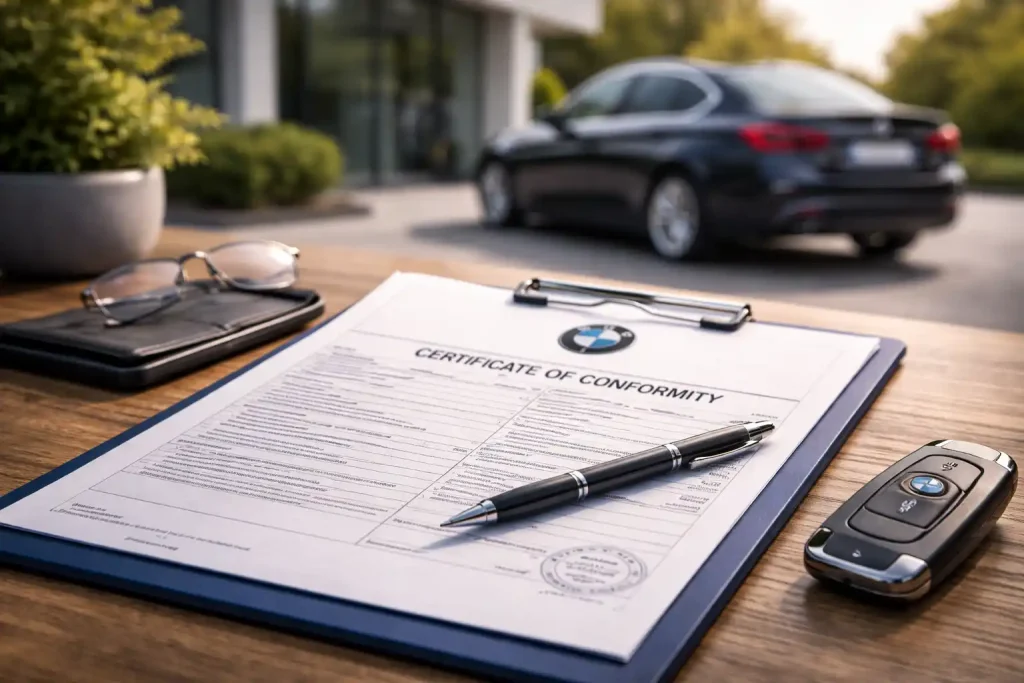
The COC exists within the framework of EU type approval — a system through which manufacturers certify that a specific vehicle model meets European standards before it can be sold in the EU. When a manufacturer builds cars for the European market, each model receives a type approval certificate, and individual vehicles produced under that approval receive a COC.
Here is the fundamental issue with imports from Japan and the US: the COC is not available for vehicles ever registered outside of the EU. In those countries, the vehicle was subjected to national homologation that is valid only in the country where it was conducted. Therefore, the vehicle does not necessarily comply with EU standards.
A Toyota Camry built for the US market and a Toyota Camry built for the European market may share a name and a silhouette, but they are technically different vehicles. The US version may have different headlights, a different speedometer calibration, different emissions controls, different passive safety equipment, and different bumper heights. None of these details are visible at a glance, but all of them matter to a registration authority.
The COC is not issued or is not valid for vehicles manufactured outside the European Union and not approved in accordance with European standards, or vehicles imported individually that have passed a national or individual approval — such as American or Japanese vehicles imported privately.


There is one important exception that gives some importers false hope — and occasionally genuine hope, depending on the specifics.
Some European manufacturers — BMW, Mercedes-Benz, Audi, Volkswagen, Volvo — sell vehicles in Japan and the US that are built on the same production lines as their European equivalents, with only minor market-specific adjustments. In certain cases, particularly for older models or specific trims, a manufacturer may be willing to certify that a US or Japan-spec unit meets EU type approval requirements.
This process, sometimes called a manufacturer’s declaration of conformity extension, involves the manufacturer certifying that the non-EU unit meets EU standards either as-is or after specified modifications. This pathway is rare, time-consuming, and dependent entirely on the manufacturer’s willingness to cooperate.
If your vehicle is a European-brand car exported to Japan or the US and later brought back to Europe, it is worth contacting the manufacturer’s customer relations department directly to ask whether a COC can be issued. For BMW US-spec vehicles, for instance, BMW AG’s position is typically that US models do not comply with European type approval — meaning no COC will be issued regardless of the VIN.
A practical way to check before investing time in this route: look for a small black label on the door jamb or VIN plate that contains a code starting with “e” followed by numbers (e.g. e1*…*…). This is a European type approval reference. If it is present, the vehicle was built to EU specifications and a COC may be retrievable through services like auto-coc.eu. If it is absent, the vehicle is not EU-spec and a standard COC cannot be issued for it.
If a standard COC is not available — which is the case for the vast majority of Japanese and US imports — registration authorities across the EU require a process known as Individual Vehicle Approval (IVA), sometimes also called individual homologation or single vehicle approval depending on the country.
The IVA scheme is used to obtain approval for mass-produced vehicles from countries outside the European Union — such as the USA, Japan, and China — which were originally intended for registration in their country of origin. Due to the large number of such vehicles being imported into the EU in recent years, the European Commission introduced harmonised technical and administrative requirements for individual vehicle approval of M1 and N1 category vehicles produced in large series for third countries.
In practical terms, IVA involves a detailed technical inspection by an authorised authority in the destination EU country. The vehicle is assessed against EU standards point by point, and modifications are typically required before approval is granted.

Whether you are importing a JDM sports car from Japan or a pickup truck from the US, the technical gaps between your vehicle and EU standards follow a predictable pattern.
Headlights. Japanese headlights dip to the left, designed for left-hand traffic. EU countries drive on the right, requiring lights that dip to the right. Depending on the vehicle, this may be solvable with beam deflectors or may require full headlight replacement. US headlights are a different standard entirely (SAE vs. ECE) and almost always require replacement with ECE-compliant units.
Speedometer. US vehicles display speed in miles per hour. Japanese vehicles display speed in kilometres per hour but may not meet EU calibration standards. Either way, the speedometer must be confirmed compliant.
Rear fog light. Standard in the EU, absent or non-standard on most Japanese and American vehicles. A compliant rear fog light must be installed.
Emissions compliance. This is often the most complex area. US vehicles meet EPA standards; Japanese vehicles meet MLIT standards. Neither is automatically equivalent to Euro emissions standards. Older vehicles may qualify for historic vehicle exemptions. Newer vehicles may require catalytic converter upgrades, ECU recalibration, or other engine modifications before they can pass EU emissions testing.
Bumper height and pedestrian safety. US and Japanese safety standards differ from EU pedestrian impact requirements, particularly for vehicles manufactured after 2012.
Daytime running lights. Mandatory in the EU, not standard on older US or Japanese models.
The scope and cost of these modifications varies enormously depending on the vehicle, its age, and the specific requirements of the destination EU country. A 30-year-old Nissan Skyline GT-R will face a very different compliance path than a 2020 Ford F-150.
Official, manufacturer-issued certificates for 90+ brands.
Express delivery available — PDF sent immediately upon processing.
Browse All COCs →While the EU has harmonised the technical requirements for IVA, the practical implementation varies significantly between member states.
Germany has some of the strictest requirements. Individual approval (Einzelabnahme, known as §21 StVZO approval) must be carried out by TÜV, DEKRA, or GTÜ. The process is thorough and can be expensive, particularly for vehicles requiring significant modification.
France operates a system called Réception à Titre Isolé (RTI), which involves a detailed technical inspection by DREAL (the regional environmental and transport authority). France has a reputation for strict enforcement, particularly on emissions.
Spain requires individual homologation through the DGT (Dirección General de Tráfico), which assesses the vehicle against EU type approval standards. Vehicles that are 30 years or older may qualify as historic vehicles, following a simplified process with relaxed standards.
The Netherlands and Belgium are widely regarded as among the more accessible EU countries for registering non-EU specification vehicles. The RDW in the Netherlands in particular has a well-established process for individual approval that is considered relatively straightforward by European standards.
Poland offers a simplified path for US imports: Poland does not require vehicles imported from the USA to have European homologation certificates. While homologation is not mandatory, cars must still undergo technical inspections to ensure they comply with basic safety and environmental standards.
If you are planning an import and have flexibility on where to register the vehicle within the EU, it is worth researching country-specific requirements before committing to a destination.
Vehicles from the US and Japan (JDM) enjoy a much more accessible registration path in the EU if they qualify as historic vehicles.
To summarise the one scenario where a standard EU COC can be obtained for a vehicle coming from Japan or the US: the vehicle must have been originally built for the EU market, left the EU (or was exported directly from the factory to a non-EU country), and was never type-approved or homologated under a national non-EU scheme.
In this case, the vehicle will have an EU type approval code on its VIN plate, and the manufacturer’s records will include its technical data as an EU-spec vehicle. A COC can be retrieved — either through the manufacturer directly or through a specialist service such as auto-coc.eu, which covers over 90 vehicle brands and can verify availability instantly by VIN.
This applies, for example, to a BMW 3 Series produced in Germany, exported new to Japan as an EU-spec vehicle for a European expatriate, and later re-imported to Europe. It does not apply to a BMW 3 Series built to Japanese domestic market specifications.
Before committing to the purchase of a Japanese or US vehicle for import to Europe, work through these steps in order:
Step 1: Check the VIN plate for a European type approval code. If present, contact auto-coc.eu to verify whether a COC is retrievable.
Step 2: If no EU type approval code is present, research the IVA or individual homologation process in your target EU country. Identify an authorised inspection authority and request a preliminary assessment of the vehicle’s compliance gaps.
Step 3: Obtain a pre-purchase technical assessment of the specific modifications likely to be required and their estimated cost. Add this to your total landed cost calculation before agreeing on a purchase price.
Step 4: Factor in customs duty (typically 10% of the vehicle’s declared value), import VAT (19–25% depending on the EU country), and any applicable registration tax — in addition to shipping, homologation, and modification costs.
Step 5: Ensure that the vehicle is not classified as a salvage or write-off in its country of origin. Seriously damaged vehicles cannot be registered in the EU regardless of homologation status.
Enter your VIN, select your brand, and choose standard or express delivery.
Best price guaranteed · EU-compliant · Multilingual support


