

Written by
I. Constantin

Date released
22.06.2026
Comments
0 so far - be the first!
The Certificate of Conformity for an electric vehicle is an excellent document for confirming the vehicle’s type approval status, verifying its identity, and establishing its original technical specifications. It will tell you the battery’s gross and net capacity in kilowatt-hours, the WLTP-certified range on a full charge, the charging input specifications, and the CO2 emissions figure of zero that makes EVs attractive from a tax perspective in most EU countries.
What it will not tell you is any of this information as it applies to the specific battery in the vehicle you are considering purchasing today, after several years of use, charging cycles, and varying temperature exposure. The COC is a snapshot of the vehicle when it was new. Battery degradation is the story of everything that happened after that snapshot was taken, and it is entirely absent from any COC regardless of how recent the document is.
For used EV buyers, understanding this gap is not a minor technical footnote. It is one of the most important practical considerations in the entire purchase decision.
Lithium-ion batteries degrade over time as a result of charge and discharge cycling, calendar aging, and thermal stress. This is not a defect or a malfunction. It is the inherent electrochemical behaviour of the technology, and it affects every EV battery regardless of the manufacturer, chemistry, or care taken in use.
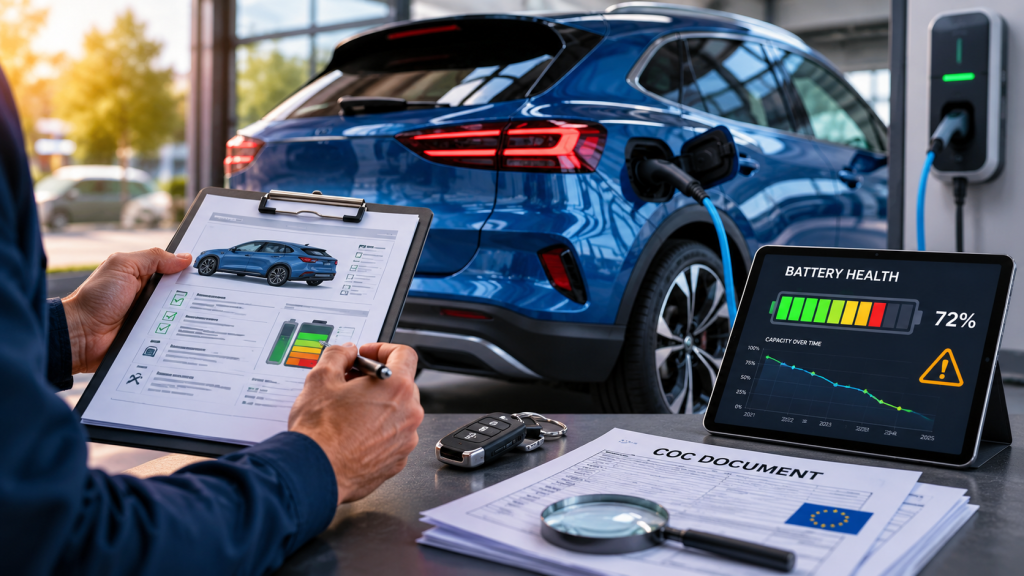
The practical result of degradation is a reduction in the battery’s usable capacity, which translates directly into a reduction in real-world driving range. A battery that started with 75 kWh of usable capacity and has degraded to 85 percent of its original capacity now offers approximately 64 kWh of usable energy. If the vehicle originally achieved 420 km of WLTP range, the degraded battery will produce proportionally less range under comparable conditions.
The rate of degradation varies considerably between manufacturers, battery chemistries, and individual usage patterns. Vehicles that have spent significant time connected to fast DC chargers degrade faster than those charged predominantly on slower AC chargers. Vehicles that regularly sit at very high or very low states of charge degrade faster than those managed within a mid-range charge window. Vehicles operating in extreme temperatures degrade faster than those in temperate climates.
None of this usage history or its impact on the battery’s current state is captured anywhere on the COC.
Even for a brand new EV with zero degradation, the gap between the WLTP range stated on the COC and the real-world range a driver experiences on a daily basis is significant. WLTP testing is conducted under specific controlled conditions — a defined temperature range, a defined speed profile, and a defined auxiliary load — that rarely match the conditions of real-world driving.
Cold weather is the most significant real-world variable. At temperatures below 5 degrees Celsius, lithium-ion batteries deliver substantially less energy than at the temperatures used in WLTP testing. A vehicle with a 400 km WLTP range stated on the COC may deliver 270 to 300 km of real-world range in winter driving conditions, even with zero degradation.
Add degradation to this picture and the gap between COC figures and daily reality widens further. A three or four year old EV with 15 percent battery degradation and cold weather operation may deliver 60 to 65 percent of its COC-stated WLTP range on a challenging winter day. Buyers who purchase a used EV expecting to replicate the COC range in daily use will be consistently disappointed.
The COC figure is best understood as a standardised comparison benchmark rather than a real-world promise. It allows you to compare different EVs on an equal footing. It does not predict what you will see on the dashboard range estimator in February.


Most EV manufacturers offer a battery warranty separate from the general vehicle warranty, typically covering the battery for a defined period (commonly 8 years) and/or a defined mileage, with a guaranteed minimum state of health threshold (commonly 70 to 75 percent of original capacity).
This warranty is relevant to used EV buyers in two ways. First, it provides a floor below which the manufacturer is obligated to repair or replace the battery while the warranty is active. Second, its remaining duration and terms are a factor in the vehicle’s residual value and risk profile for the buyer.
Importantly, the battery warranty does not appear on the COC. It is a commercial obligation of the manufacturer, not a regulatory document. Its terms, remaining duration, and transferability to subsequent owners need to be verified through the manufacturer’s warranty documentation or service records rather than through the certificate of conformity.
Before purchasing a used EV, confirm the battery warranty status with the manufacturer or an authorised service centre. For some brands, warranty transfer to subsequent owners within the warranty period is automatic. For others, a transfer registration process is required. And for some older vehicles that have passed the warranty period, no battery warranty applies at all.
How to Assess Battery Health Before Buying: The COC cannot tell you the battery's current health, but several tools and approaches can provide a meaningful assessment before you commit to a purchase.
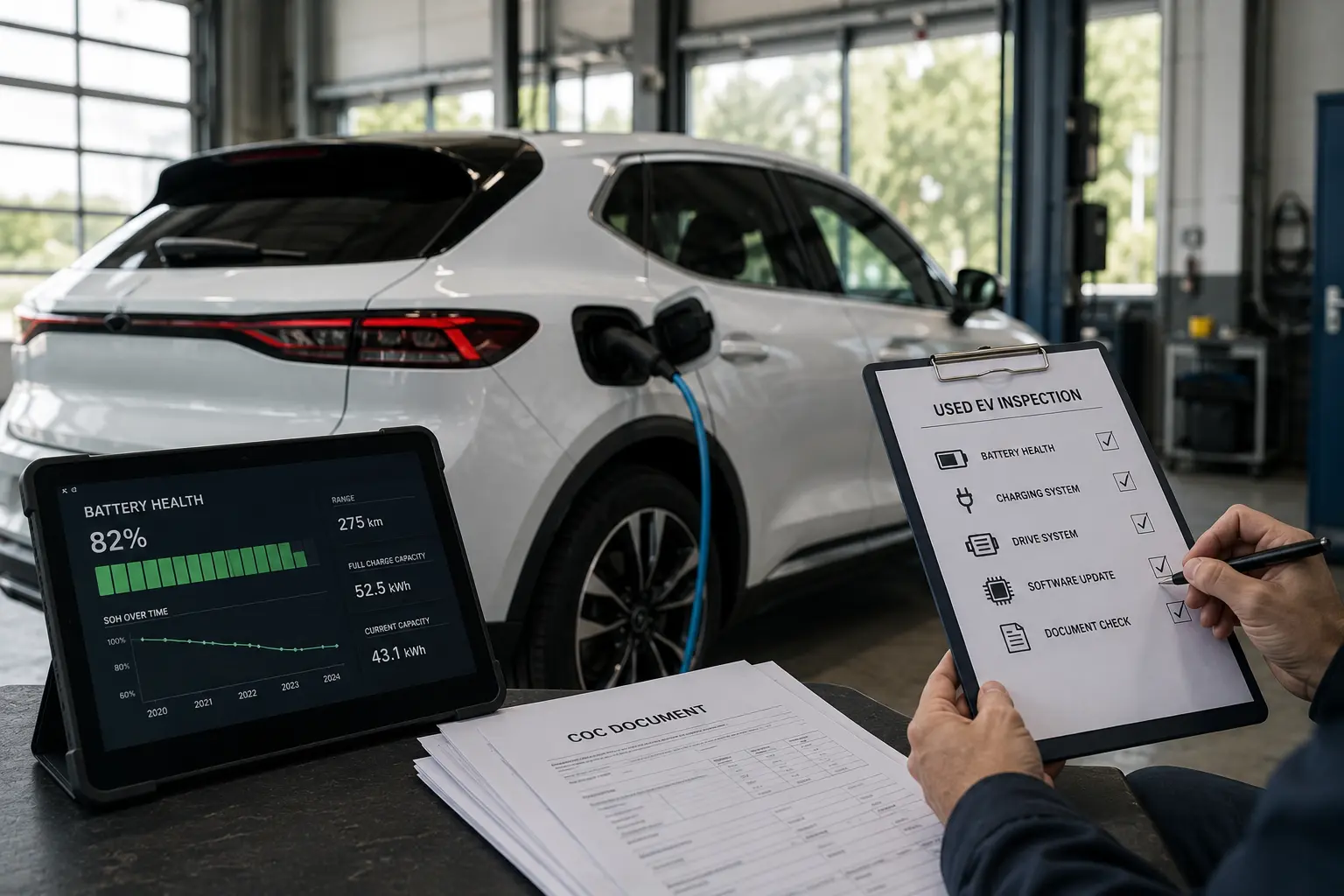
The most reliable method is a battery state of health (SOH) readout from a manufacturer-authorised service centre. This uses the vehicle's battery management system data to produce a percentage figure representing the battery's current capacity relative to its original specification. For many major EV brands, this readout can be obtained during a standard service appointment or as part of used vehicle certification programmes.
Tools connected to the vehicle's OBD port can read battery management system data for many EV models and produce a SOH estimate when a manufacturer service centre is inaccessible. Note that accuracy varies between models and diagnostic platforms. For some brands with proprietary systems (Tesla being the most prominent example), third-party access is limited, making manufacturer tools the only reliable choice.
A simpler but less precise method is to charge the battery to 100 percent and compare the indicated range on the dashboard against the vehicle's original WLTP figure. If the indicated range at full charge is significantly below the original WLTP specification, this suggests meaningful degradation. This method is imprecise due to varying algorithms and recent driving conditions, but serves as a useful rough indicator without diagnostic equipment.
The used EV market has recognised the battery health information gap and a growing number of initiatives are developing battery health certificates as a standard part of used EV transactions. Several manufacturers now offer battery health reports as part of certified pre-owned programmes, providing buyers with a documented SOH figure that supplements the information on the COC.
Independent certification schemes are also emerging, with third-party organisations offering battery health assessments and certificates that can travel with the vehicle through multiple ownership cycles. These certificates do not replace the COC for registration purposes but provide the information the COC cannot: the current state of the battery as it exists today rather than as it was when the vehicle left the factory.
For cross-border used EV purchases, asking the seller for a battery health certificate or arranging an independent assessment before completing the transaction is increasingly standard practice among informed buyers. It is not yet universal, but the market is moving in this direction as the volume of used EVs in circulation grows and buyer awareness of the degradation question increases.
Before purchasing any used electric vehicle from another EU country, verifying the COC data through auto-coc.eu gives you the baseline specification against which to assess the vehicle’s current condition. The platform confirms the battery’s original capacity, the WLTP range as certified, and the charging specifications — all the data points that define what the vehicle was designed to deliver.
Armed with this baseline, the battery health assessment becomes a comparison exercise: how does this specific vehicle’s current measured SOH compare to the specifications on its COC? The gap between those two data points is the most honest summary of how much the battery has aged and what real-world range you can realistically expect.
Official, manufacturer-issued certificates for 90+ brands.
Express delivery available — PDF sent immediately upon processing.
Browse All COCs →For most people ordering a COC through Auto-COC.eu, the realistic total timeline from order to physical document in hand is 5–8 business days for standard delivery, or 4–6 business days with express. If you need to begin registration before the physical document arrives, the digital PDF sent upon processing gives you a head start.
The two things most within your control are: getting the VIN right first time, and choosing express delivery if timing is at all tight. Everything else is largely determined by the vehicle manufacturer — and Auto-COC.eu handles that part for you.
Enter your VIN, select your brand, and choose standard or express delivery.
Best price guaranteed · EU-compliant · Multilingual support


