


Written by
I. Constantin

Date released
23.06.2026
Comments
0 so far - be the first!
France is the third largest used car market in the EU after Germany and the United Kingdom, and for buyers across Southern, Central, and Eastern Europe it represents a genuinely attractive source of well-maintained vehicles at competitive prices. French motorists tend to keep their cars in reasonable condition, the service network is dense, and the documentation culture is more formalised than in some other EU markets.
What makes France different from Germany or Belgium for cross-border buyers is the documentation system itself. French vehicle paperwork uses terminology, formats, and administrative processes that are specific to the French state and that can be confusing for buyers encountering them for the first time. Understanding what each document is, what it proves, and what you need to do with it before the car leaves France is the difference between a smooth registration process and weeks of administrative back-and-forth.
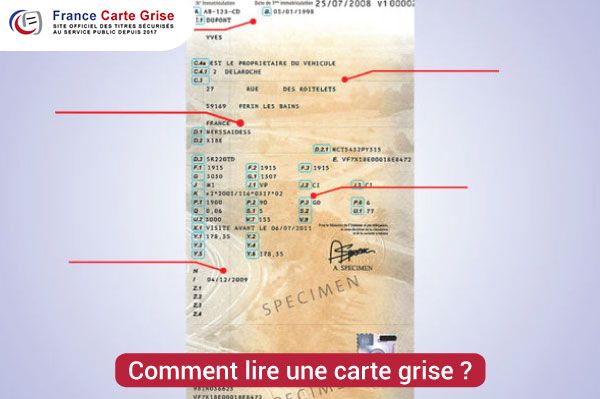
The Carte Grise is the foundation document of French vehicle ownership. Its official name is the Certificat d’Immatriculation, but it has been called the Carte Grise for decades after the grey card stock on which it was historically printed. It is the French equivalent of Germany’s Zulassungsbescheinigung and the UK’s V5C logbook.
The Carte Grise contains the vehicle’s registration number, make, model, VIN, engine specifications, first registration date, and the name and address of the registered owner. When you purchase a vehicle from a French dealer, the Carte Grise must be transferred into your name as the new owner before the vehicle can be exported and re-registered abroad.
For export sales, the process involves the dealer initiating a change of ownership through the French ANTS system (Agence Nationale des Titres Sécurisés), the online platform through which all French vehicle registration transactions are processed. The result is a Certificat de Cession confirming the transfer of ownership from the dealer to you, alongside the updated or surrendered Carte Grise documentation.
As a foreign buyer taking the vehicle out of France permanently, you will need the Carte Grise in its export-annotated form or a Certificat de Cession clearly showing you as the new owner. Without this, the legal chain of ownership from the French registered keeper to you is not established, and your national registration authority will not process the application.
The Certificat de Cession is the formal transfer of ownership document completed when a vehicle changes hands in France. It is a standardised Cerfa form (Cerfa 15776) that both the seller and buyer sign, recording the details of both parties, the vehicle’s VIN and registration number, the odometer reading at the point of transfer, and the date and time of the transaction.
When buying a car from a French dealer, insist on receiving the completed and signed Certificat de Cession at the point of handover. This document, combined with the Carte Grise, establishes the legal chain of ownership that your registration authority requires. A dealer who is reluctant to complete this form properly should be treated with caution.

The Contrôle Technique is France’s mandatory periodic vehicle inspection, broadly equivalent to Germany’s TÜV or the UK’s MOT. Vehicles over four years old must pass a Contrôle Technique every two years, and the certificate is a standard part of the documentation package for any used vehicle sold in France.
The Contrôle Technique certificate records the inspection date, the odometer reading at inspection, the inspector’s findings across a range of technical and safety checks, and the overall result. A passed inspection is marked as Favorable. An inspection with minor deficiencies that do not immediately prohibit road use is marked as Défavorable mineur, giving the owner a defined period to rectify the issues. A failed inspection with serious safety deficiencies is marked as Défavorable majeur, which in theory prohibits the vehicle from being driven except to a repair workshop.
The Certificate of Conformity is required for re-registering a French vehicle in any other EU member state, and it is the document that most French dealers either do not have or do not think to mention unless specifically asked. This is not unique to France, but it is worth emphasising because the French administrative culture around vehicle documentation is strong in some areas and weak in others, and the COC sits firmly in the latter category.
French fleet operators, leasing companies, and many private sellers simply do not retain the COC after original registration. The document served its purpose at the point of first registration in France and was not needed again for any subsequent French administrative process. When the vehicle is sold to a foreign buyer who needs it for re-registration abroad, the absence becomes a problem.
Ask the French dealer explicitly whether the COC is available before committing to the purchase. If it is not, initiate a retrieval request through auto-coc.eu using the vehicle’s VIN. The platform covers the full range of makes and models sold in the French market and can retrieve the document significantly faster than going through manufacturer channels directly. For popular French brands including Renault, Peugeot, Citroën, and DS, retrieval is typically fast and reliable.


When a vehicle is permanently exported from France, the seller is required to submit a Déclaration de Cession to the French authorities confirming the transfer of ownership and, in the case of an export, the intention to remove the vehicle from the French registration system. This triggers the administrative closure of the vehicle’s French registration file.
For the buyer, the practical implication is that the vehicle’s French registration plates are no longer valid once the export declaration is filed. You will need to arrange transit insurance and, where required, temporary export plates before driving the vehicle from the dealer’s premises. Confirm with the dealer exactly when the export declaration will be filed and ensure your transit arrangements are in place before that moment.
Some dealers handle the entire export process and can provide a temporary transit document. Others expect the buyer to manage the transit logistics independently. Clarify this before handover and get the arrangement confirmed in writing.
Official, manufacturer-issued certificates for 90+ brands.
Express delivery available — PDF sent immediately upon processing.
Browse All COCs →Beyond the core registration documents, several additional items are worth requesting from a French dealer that can simplify your registration process and protect your interests as a buyer.
The carnet d’entretien or livret d’entretien is the French service booklet, equivalent to the German Scheckheft. Complete with stamps from authorised workshops, this document demonstrates the vehicle’s maintenance history and is valuable both for the registration process and for understanding the vehicle’s condition.
If the vehicle was sold new by the same dealer group, a first sale invoice may be available and provides useful historical context about the vehicle’s original specification and price. For vehicles still within the manufacturer’s warranty period, documentation of the remaining warranty coverage and its transferability to a non-French owner is worth obtaining in writing.
For electric and plug-in hybrid vehicles purchased from French dealers, confirm whether any French EV subsidy (bonus écologique) was applied at original purchase and whether this creates any residual obligation on the vehicle’s ownership or modification that could affect your registration process.
Enter your VIN, select your brand, and choose standard or express delivery.
Best price guaranteed · EU-compliant · Multilingual support


