
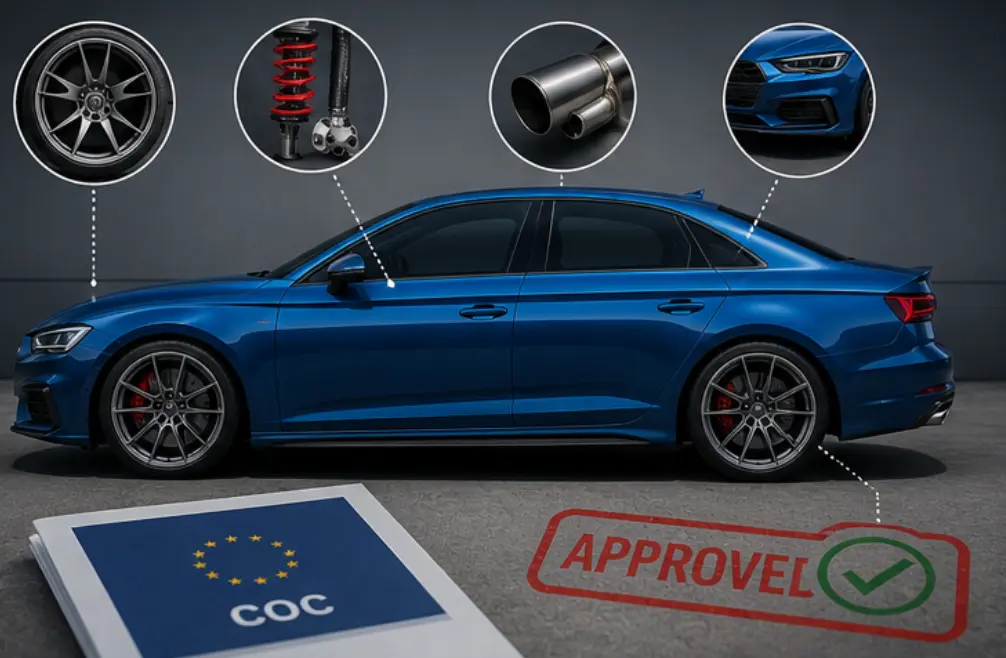
The Certificate of Conformity is a snapshot of your vehicle as it left the factory. Every specification stated on that document — engine output, emissions figures, dimensions, weight, lighting configuration — describes a vehicle in its original, type-approved state. The moment you make a modification that takes the vehicle outside those parameters, you introduce a gap between what the COC says and what the car actually is. How serious that gap becomes depends entirely on the nature of the modification and the circumstances in which it is discovered.
Most car owners modify their vehicles at some point — even if only to fit aftermarket wheels or tint the windows. The vast majority of these changes have no practical impact on the COC or on registration. Some modifications, however, create genuine legal and administrative problems that are worth understanding before the work is done rather than after.
EU vehicle type approval is the process by which a manufacturer demonstrates that a vehicle model meets all applicable technical standards before it can be sold. The COC is the document issued for each individual vehicle confirming that it conforms to the approved type. The approval covers a defined set of parameters, and vehicles are sold with the implicit understanding that they will remain within those parameters throughout their operational life.
EU law does not prohibit vehicle modifications. It does, however, require that modified vehicles continue to meet the technical standards applicable to their category, and it gives national authorities the power to withdraw registration or refuse re-registration for vehicles that have been modified in ways that take them outside compliance. The specific rules governing which modifications require re-approval vary between member states, which creates a patchwork of national implementations of a broadly shared European framework.

The majority of popular modifications fall into a category that registration authorities across the EU treat as non-material — changes that do not alter the vehicle’s fundamental technical characteristics as described in the type approval.
Cosmetic exterior changes such as paint colour, vinyl wraps, and body styling additions that do not alter the vehicle’s width, height, or frontal area are generally unproblematic. Interior modifications including seat upholstery, steering wheel replacements, and infotainment upgrades do not affect type approval. Tyre and wheel changes within the size ranges specified in the COC or the vehicle handbook are typically acceptable. Audio system upgrades and lighting interior changes have no type approval implications.
For these categories of modification, the COC remains valid and unaffected. Registration and periodic inspection processes treat the vehicle as conforming to its original type approval, and no additional documentation is required.


The modifications that create genuine COC and registration issues are those that alter parameters specifically stated on the certificate or that affect the vehicle’s compliance with category-specific technical standards.
Engine tuning and remapping is the most commonly encountered issue. A vehicle sold with a 150 kW engine that has been remapped to produce 185 kW is no longer conforming to the power output stated on its COC. At periodic inspection, if the vehicle is tested on a dynamometer and produces significantly more power than the COC states, this discrepancy will be noted. In some EU countries this is treated as an administrative matter. In others it is a failed inspection that requires the modification to be reversed or formally re-approved before the vehicle can pass.
Suspension modifications that lower the vehicle beyond a certain threshold affect the ground clearance figures on the COC and can bring the vehicle into conflict with minimum ground clearance requirements for its category. Some EU countries have specific rules on maximum permitted lowering without re-approval. Exceeding these limits is a failed inspection outcome in jurisdictions that check for it.
LPG and CNG conversions are a structural modification that creates a new emissions profile different from the one on the COC. Most EU countries require a separate technical approval for gas conversion installations, and the COC must be supplemented with an installation certificate from an approved converter. Without this supplementary documentation, the vehicle’s registration status can be challenged.
Significant lighting modifications — particularly LED or HID conversions on vehicles not originally approved for these light sources — affect the COC’s lighting specification entries. Many EU countries check lighting compliance during periodic inspection, and non-type-approved lighting changes are a common failure reason.
For most owners, the COC issue only becomes acute at one of two moments: a periodic technical inspection or a cross-border re-registration. Both involve a direct comparison between what the COC states and what the vehicle physically is.
Periodic inspections vary in their depth across EU member states. Some run a standard checklist that would not catch most performance modifications unless they are dramatic and obvious. Others, particularly in countries with stricter technical inspection regimes, include dynamometer testing, emissions analysis against COC figures, and physical dimension checks.
The practical risk for a vehicle with performance modifications is that it passes inspection in a country with a lighter touch and fails in a country with stricter protocols. This is particularly relevant for buyers importing modified vehicles from one EU country to another — the vehicle may have been passing regular inspections in its country of origin without issue, and then fail at the point of re-registration in the destination country where inspection standards differ.
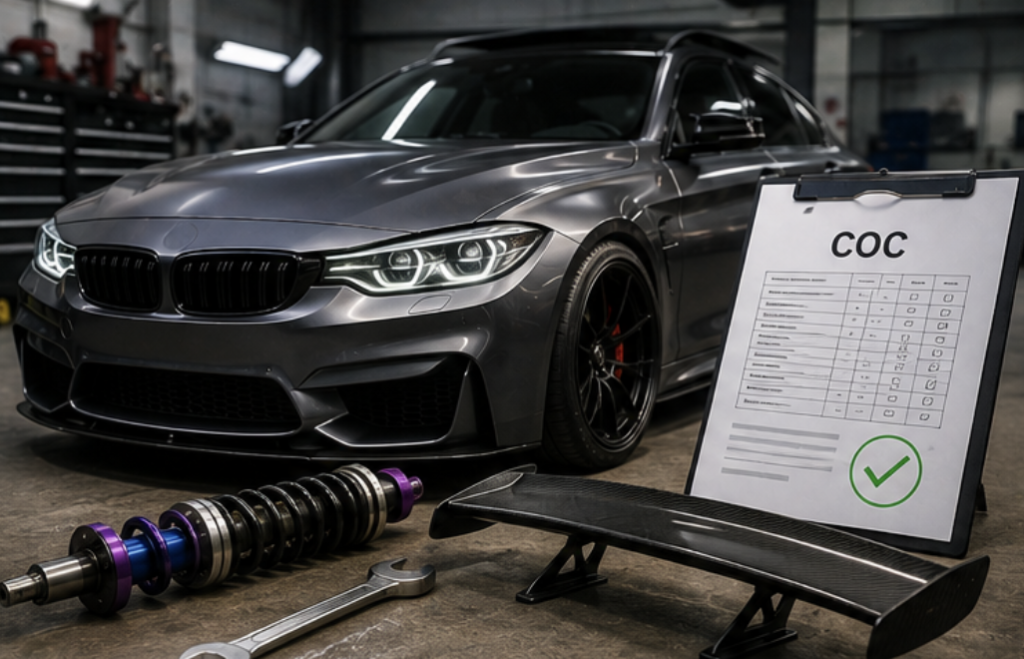
If you have purchased a modified vehicle and need to register it in an EU country where the modifications create a COC discrepancy, you have several options depending on the nature and extent of the changes.
Reverting the modifications to the original specification is the simplest solution from a documentation standpoint. If the modification is fully reversed and the vehicle is restored to its factory configuration, the original COC is valid without any additional steps.
For modifications that cannot easily be reversed — LPG conversions, significant structural changes, or engine swaps — the route is individual technical re-approval through the national vehicle authority. This involves presenting the vehicle for inspection with all documentation relating to the modification work, and the authority assessing whether the modified vehicle meets the applicable standards in its current form.
For performance modifications within relatively modest ranges, some EU countries operate a system of approved tuning certification — where modifications carried out by certified tuners using type-approved parts can be registered as approved modifications without requiring full individual re-approval. Check whether this pathway is available in your specific country before committing to either reversal or full re-approval.
Throughout any of these processes, having a current and accurate COC for the vehicle in its pre-modification state is essential as the baseline document. If you need to retrieve or reissue the COC as part of sorting out a modification-related registration issue, auto-coc.eu can provide the document quickly and without the delays associated with going through manufacturer channels directly.
Official, manufacturer-issued certificates for 90+ brands.
Express delivery available — PDF sent immediately upon processing.
Browse All COCs →The COC question and the insurance question are separate but closely related. Most vehicle insurance policies require the policyholder to disclose modifications that affect the vehicle’s performance, value, or risk profile. Failing to disclose a performance remap or a suspension modification can invalidate your insurance policy in the event of a claim, regardless of whether the modification caused or contributed to the incident.
Always notify your insurer of any modifications before they are carried out. Many insurers will simply note the change with no premium impact for minor modifications. For significant performance increases, the premium adjustment may be meaningful, but it is far less significant than the consequence of a major claim being rejected because of an undisclosed modification.
Enter your VIN, select your brand, and choose standard or express delivery.
Best price guaranteed · EU-compliant · Multilingual support


