

Written by
I. Constantin

Date released
26.03.2026
Comments
0 so far - be the first!
Importing a used car from another European country is one of the most effective ways to save money on your next vehicle purchase.
But alongside those savings come a set of hidden risks when importing a used car that catch thousands of buyers every year completely off guard, costing them far more in unexpected expenses, failed registrations, and legal complications than they ever saved on the purchase price.
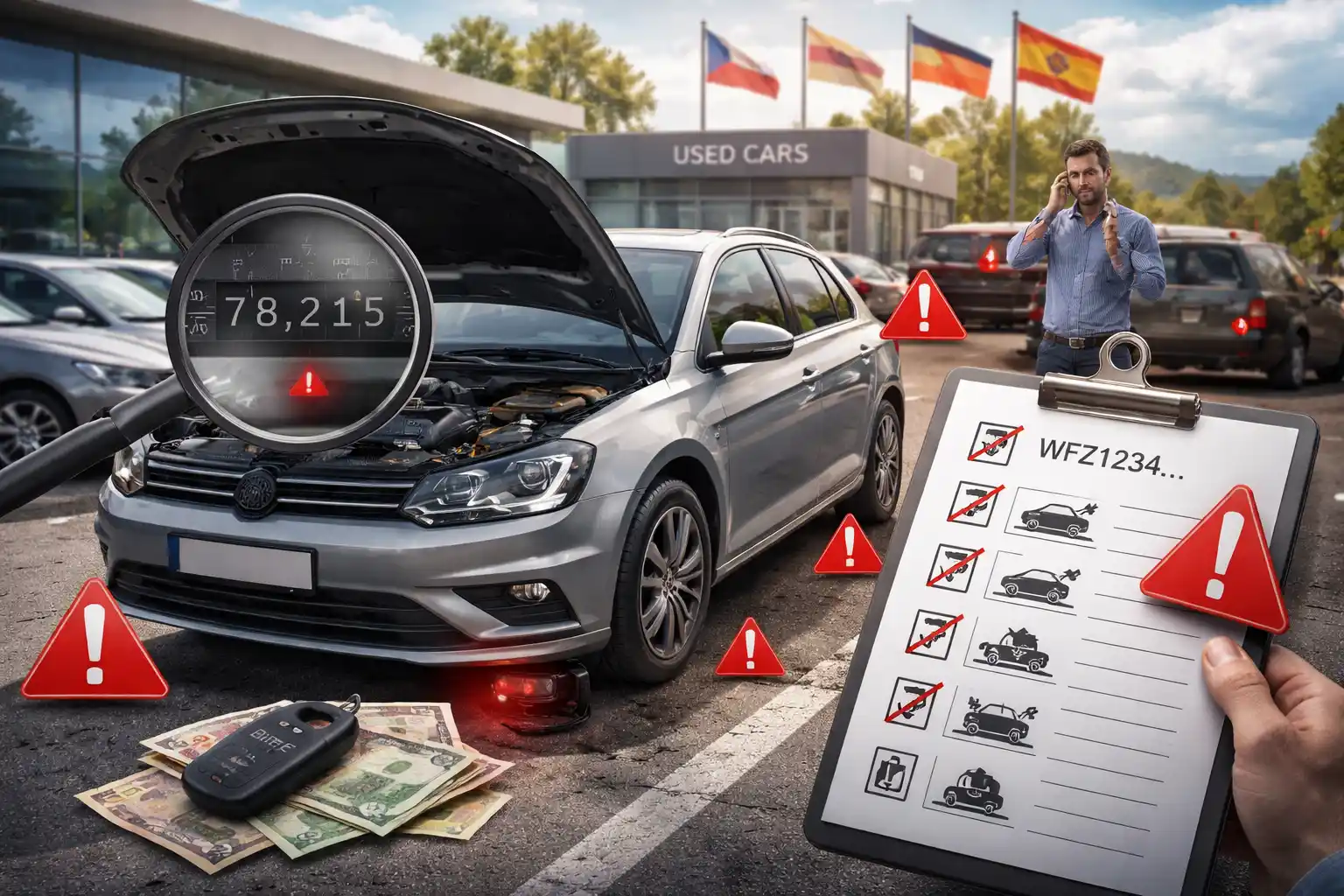
This guide covers the seven most dangerous hidden risks when importing a used car from Europe and gives you specific, actionable steps to avoid every one of them.
Mileage fraud is the single most prevalent hidden risk when importing a used car in Europe, and cross-border imports make it dramatically harder to detect than domestic purchases.
When a vehicle has been registered in two, three, or four different countries over its lifetime, its mileage history is fragmented across multiple national databases. A buyer checking only the current country’s records will see a clean, consistent history. The manipulation happened in a previous country, and without a multi-database check, there is no way to know.
Without a VIN report that queries databases across all previous registration countries simultaneously, the manipulation is completely invisible.
The Certificate of Conformity is the official document issued by the vehicle manufacturer that confirms your specific vehicle meets all applicable EU technical, safety, and environmental standards. It contains your VIN, engine specifications, CO2 emissions, dimensions, and EU type approval number. Every EU member state requires it for vehicle registration, without exception.
And yet a missing COC is one of the most common hidden risks when importing a used car, because private sellers frequently do not have it and do not mention its absence until after the sale is agreed.
Without a COC you cannot register the vehicle in your new country, and, obtaining a replacement COC takes up to 15 business days and costs between 50 and 315 euros depending on the brand, which adds time and cost to a purchase you thought was complete. In some cases, for older or unusual vehicles, the manufacturer may no longer be able to issue a COC at all, in which case you face the significantly more expensive and time-consuming individual type approval process as the only alternative.


In most EU countries, a vehicle under a finance or leasing agreement is legally owned by the lender or leasing company, not the individual driving it. If that individual sells the vehicle to you without the lender’s knowledge or consent, you may be purchasing a vehicle you will never legally own, regardless of how much you paid for it.
This problem is particularly acute in cross-border purchases because the finance records of one country are rarely visible to buyers in another.
A vehicle under active leasing with a German bank, exported and sold privately in Belgium, will show no Belgian finance records because the agreement was registered in Germany. The German leasing company retains full legal ownership and can repossess the vehicle from you, the innocent buyer in Belgium, with no compensation obligation. You would be left with no vehicle and no recourse against a seller who may be impossible to trace.
A vehicle that has been in a significant collision may have been declared a write-off (also known as a total loss) by an insurance company in its country of origin and then repaired and remarketed without disclosure of that status. In some countries, written-off vehicles can be legally re-registered after repair with no obligation to disclose the write-off status to subsequent buyers. In others, the write-off status must be declared.
Plus, a vehicle declared a structural write-off has sustained damage to its chassis or safety cell that, even after repair, may not provide the same level of occupant protection in a subsequent accident. Airbag deployment and re-packing, if not carried out to manufacturer specification, can fail in a collision.
Structural repairs that appear cosmetically acceptable may hide weaknesses that only become apparent under impact loading. In addition to the safety implications, a vehicle with a write-off history will have dramatically lower resale value once the history becomes known to a subsequent buyer.
A hidden risk when importing a used car that many buyers never consider is the possibility that the vehicle’s technical specifications do not match what is stated on its documentation. This can occur through innocent administrative error, through deliberate fraud involving document substitution, or through vehicle modifications that were never officially registered. The consequences range from a failed technical inspection to an outright refusal to register the vehicle in your new country.
Common specification mismatches include:
One of the most financially painful hidden risks when importing a used car is discovering the registration tax bill in your destination country is far higher than anticipated. This is not fraud on the part of the seller, but it is a risk that destroys many import deals, particularly for buyers coming from low-tax countries who underestimate the tax systems in high-tax destinations.
France, the Netherlands, Portugal, Ireland, and Denmark all levy CO2-based or value-based registration taxes that can add thousands or tens of thousands of euros to the total cost of importing a vehicle. France’s malus ecologique starts at 118 g/km and escalates to over 50,000 euros for very high-emission vehicles. The Dutch BPM can reach 20,000 euros or more for vehicles emitting over 160 g/km. Denmark’s registration tax can exceed 150 percent of the vehicle’s value.
Buyers who purchase a large diesel SUV in Germany at an attractive price and then attempt to register it in France or the Netherlands frequently discover that the registration tax alone exceeds the saving they made on the purchase.
The most serious of all the hidden risks when importing a used car is VIN cloning: a form of fraud where a stolen vehicle is given the identity of a legitimate, legally registered vehicle with matching documentation.
A cloned vehicle will have a VIN that passes basic checks because it is a real VIN belonging to a real vehicle somewhere else in Europe. The documentation, including the registration certificate and sometimes even a fraudulent COC, will appear to match. Only a comprehensive identity verification that includes physical VIN checks on the vehicle’s body, a stolen vehicle database check, and a cross-reference of the vehicle’s characteristics against the genuine vehicle’s history will reveal the fraud.
VIN cloning operations in Europe are sophisticated and often operate at scale. They typically target high-value models with strong demand: BMW 5 Series, Mercedes E-Class, Audi Q5, Volkswagen Touareg. A stolen example is given the identity of a legitimately registered vehicle of the same model, year, and colour. The cloned vehicle is then sold, often exported to a different country from where it was stolen to reduce the risk of identification.
If you buy a VIN-cloned vehicle, you will eventually lose it to law enforcement, with no compensation.
Each of the hidden risks when importing a used car can be detected or significantly mitigated by a single step: a comprehensive VIN history report.
Powered by carVertical • Delivered in minutes
GET YOUR VIN REPORT NOWCombined with a physical inspection and COC, it gives you 100% protection.
Importing a used car from Europe can save you thousands of euros compared to buying the same vehicle domestically, but only if you are fully aware of the hidden risks when importing a used car and take the steps necessary to protect yourself against each of them. The seven risks covered in this guide, from cross-border clocking and missing COCs to foreign leasing fraud and VIN cloning, are all entirely avoidable with the right preparation.
The two most important steps you can take before any cross-border used car purchase are running a comprehensive VIN history report here and confirming the Certificate of Conformity is available or can be obtained through Auto-COC.eu. Together, these two steps address the majority of the hidden risks when importing a used car and give you the information you need to complete your purchase with confidence. Do not skip either of them.
Protect yourself from mileage fraud, hidden accidents, and outstanding finance.
Comprehensive European History · Instant Delivery · 100% Secure


