
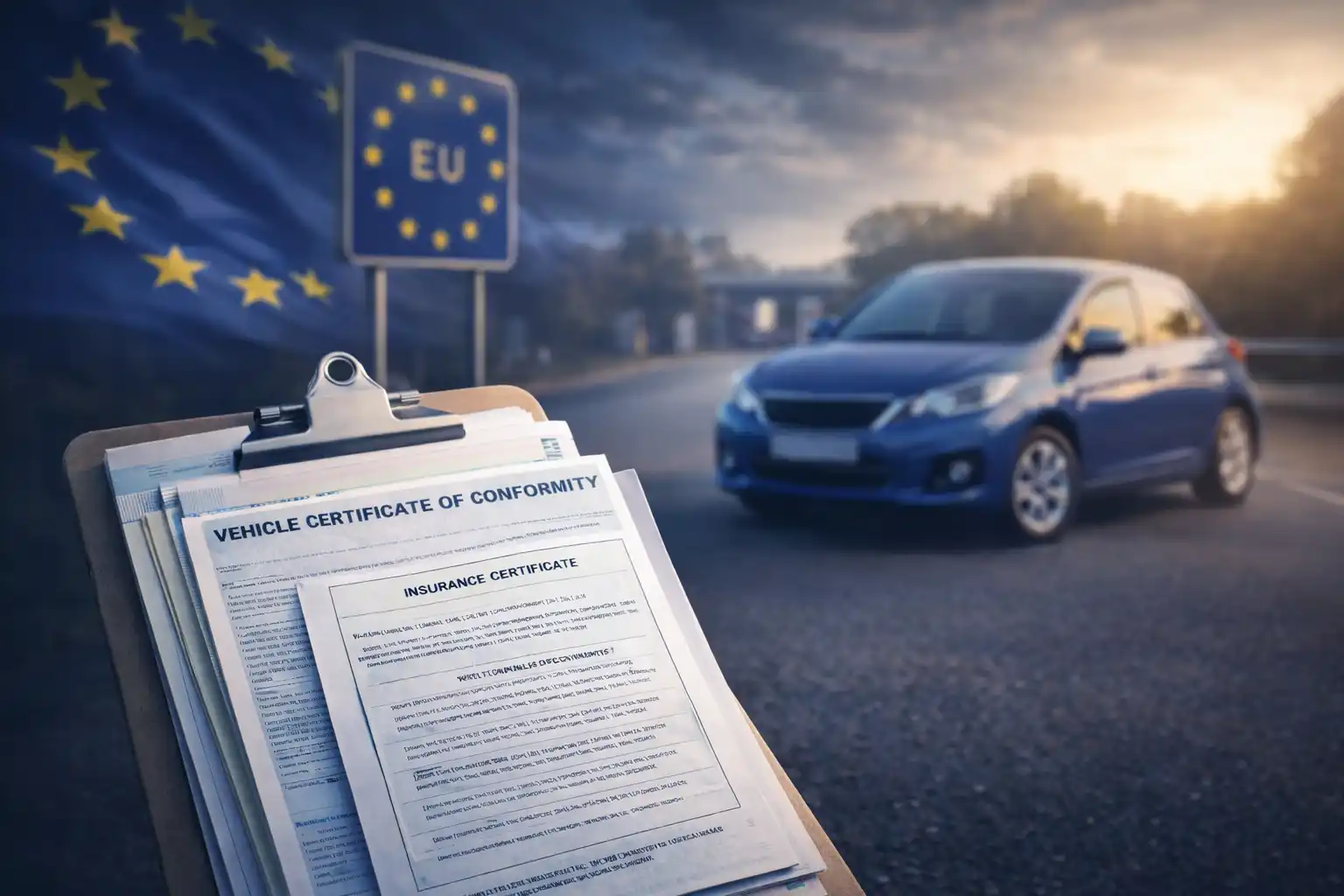
A complete guide to every document required when buying a vehicle from another EU country — and how to avoid the registration delays that catch most buyers off guard.

Written by
I. Constantin

Date released
07.03.2026
Comments
0 so far - be the first!
One of the great advantages of the European Union is the freedom to buy a car anywhere in the bloc and drive it home to register it in your country of residence. In practice, though, this freedom comes with a specific set of documents — and if any single one is missing, the entire registration process can grind to a halt.
Whether you’re buying a German BMW, a French Peugeot, or a Czech Skoda to register in Romania, Belgium, or anywhere else in the EU, this guide tells you exactly what paperwork you need, why each document matters, and what to do if something is missing when you pick up the car.
Before diving into the detail, here is every document involved in a typical cross-border EU car purchase. Not all of them are required in every situation — the sections below explain which are mandatory, which are conditional, and what each one does.
1. CERTIFICATE OF CONFORMITY (COC): Confirms EU type approval. Required for first-time registration in most EU countries. The single most important document for importers.
2. PURCHASE INVOICE: Proof of sale and price. Needed for VAT purposes and customs. Must show buyer, seller, VIN, and agreed price.
3. FOREIGN REGISTRATION DOCUMENT: The vehicle’s current registration certificate from its country of origin. Required to deregister the car before re-registration.
4. VIN HISTORY REPORT: Not legally mandatory but strongly recommended. Reveals accidents, mileage fraud, theft records, and outstanding finance before you buy.
5. TECHNICAL INSPECTION CERTIFICATE: Roadworthiness certificate (e.g. TÜV, CT, MOT). May be required by your country’s registration authority.
6. VAT / TAX DOCUMENTATION: Proof that VAT has been paid or accounted for. Varies depending on whether the seller is a private individual or a dealer.
7. TRANSIT INSURANCE: Third-party liability insurance valid for driving the car from the country of purchase to your home country.
8. YOUR ID / PASSPORT: Required by the registration authority in your home country. EU citizens typically use a national ID card or passport.
Of all the documents involved in cross-border car registration, the Certificate of Conformity is the one most likely to cause problems — and the one that most buyers don’t think about until they’re already at the registration office.
A Certificate of Conformity is an official document issued by the vehicle manufacturer (or their authorised representative) confirming that the vehicle meets all EU technical, safety, and emissions standards in force at the time of manufacture. It essentially proves that the vehicle has received EU type approval and is legally road-worthy anywhere in the European Union.
Without it, registration authorities in most EU countries either cannot process your registration, or will require expensive and time-consuming alternative technical testing — which may not even be available for all vehicle types.
You need a COC when registering any vehicle for the first time in a new EU member state — which is exactly what you’re doing when you buy a car abroad and bring it home. If the original COC was issued with the car at the time of sale, the seller may have it. In practice, it is very commonly missing, lost, or was never provided to the owner in the first place.
This is the most common stumbling block for cross-border buyers. If the seller cannot provide the COC, you have two options:
Always ask for the COC before agreeing to buy a cross-border vehicle. If the seller doesn't have it, request a reduction in the purchase price to cover the cost of obtaining a replacement — or factor it into your offer. A COC from Auto-COC.eu costs a fraction of what individual homologation does.
The purchase invoice is your legal proof of ownership transfer. It needs to contain specific information to be accepted by both tax authorities and vehicle registration offices.
When buying from a private individual in another EU country, VAT is generally not charged on the transaction. You may, however, need to pay registration tax or VAT in your home country when re-registering — the rules vary significantly by member state.
When buying from a registered dealer, VAT rules under EU Directive 2006/112/EC apply. For new vehicles (under 6,000 km or less than 6 months old), VAT is typically due in the buyer’s country of residence, not the country of sale. For used vehicles, VAT is usually settled at the point of sale in the country of origin. Keep the full VAT invoice — your home registration authority will want to see it.
Every vehicle registered in an EU country has a registration certificate — in Germany this is the Fahrzeugschein, in France the Carte Grise, in Italy the Libretto di circolazione. You need this document to complete the deregistration process in the country of origin and to prove to your home registration authority that the car was legitimately registered elsewhere.
This depends on the country of origin. Germany, for example, requires formal deregistrationbefore a car can be legally exported and re-registered abroad. The seller should provide you with proof of deregistration (Abmeldebescheinigung) at the point of handover, or arrange it before you collect the car.
In other countries — France, Belgium, Italy among them — the process works differently: deregistration and new registration are handled in parallel, and the buyer handles the process from their home country. Confirm the specific procedure for the country of purchase before you finalise the transaction.


A VIN history report isn’t a legal requirement for registration — but it is one of the most important documents you should obtain before any cross-border purchase. At the point of buying from abroad, you have no easy way to verify what the car has been through. A professional VIN check pulls data from insurance databases, border crossing records, police registers, and service histories across multiple European countries.
This matters more in cross-border purchases than in domestic ones. A car with accident history in Germany, repaired there, and now being sold privately in another country may have no visible record locally — but a VIN check will surface it.
Full carVertical report — accidents, mileage fraud, theft, finance, and full ownership history.
Available for vehicles registered across all EU member states and beyond.
Run a VIN Check →Most EU countries require a valid roadworthiness certificate as part of the re-registration process. The specific name differs — TÜV in Germany, CT in France, NCT in Ireland, ITV in Spain, RCA in Romania — but the purpose is the same: confirming the vehicle is roadworthy and meets local technical standards.
In some countries, a recent and valid foreign roadworthiness certificate is accepted for initial registration without requiring an immediate local test. In others, a new local inspection is required regardless. Check the specific rules for your country of registration before you buy — an imminent technical inspection that the car fails can be expensive.
Tax treatment of cross-border car purchases within the EU is one of the more complex areas, and the rules differ enough between countries that it is worth understanding the basics before you commit to a purchase.
Under EU law, a vehicle is considered “new” if it has been in service for less than 6 months or has been driven fewer than 6,000 km — whichever comes first. For new vehicles, VAT is always due in the country of the buyer’s residence, not the seller’s country, regardless of whether the seller is a private individual or a dealer.
For used vehicles — which covers the vast majority of cross-border private purchases — VAT is typically settled by the dealer at the point of sale in the country of origin. Private sellers do not charge VAT. However, many EU countries impose their own registration tax (sometimes called a luxury tax, environmental levy, or first-registration fee) that applies regardless of where VAT was originally paid. Romania’s RAR fee, France’s malus écologique, and Denmark’s registration tax are prominent examples.
💡 BUDGET FOR REGISTRATION TAXES
eBfore completing a cross-border purchase, check your home country’s registration tax rules. In some countries these taxes are calculated based on the vehicle’s CO₂ emissions, engine displacement, or declared purchase price — and they can be substantial. This is separate from VAT and catches many buyers off guard.
The moment you take ownership of a vehicle, you are legally responsible for it — including its presence on the road. Driving an uninsured vehicle, even across a border en route to your home country, is illegal in every EU member state.
You need at minimum third-party liability insurance (the mandatory minimum in all EU countries) valid for the journey from the point of purchase to your home. Options include:
Make sure the insurance document clearly states the vehicle’s VIN, the dates of cover, and is valid for each country you will pass through on the drive home.
The table below summarises the key document requirements for re-registering an EU-imported vehicle in some of the most common destination countries. Requirements do change — always verify current rules with your national registration authority before you complete a purchase.
| Country | COC Required? | Roadworthiness Test | Key Notes |
|---|---|---|---|
| 🇷🇴 Romania | ✓ Required | New RAR inspection required | RAR registration tax applies. COC mandatory; homologation without one is very difficult and expensive. |
| 🇫🇷 France | ✓ Required | Foreign CT accepted if valid | Malus écologique (CO₂ tax) may apply. Carte Grise (registration) obtained via ANTS portal online. |
| 🇩🇪 Germany | ✓ Required | Valid TÜV accepted | Exporting country must deregister the vehicle first. COC needed for KBA registration process. |
| 🇧🇪 Belgium | ✓ Required | New DIV inspection if cert. expired | Registration via DIV. COC must be provided; registration tax (TMC) based on engine power and CO₂. |
| 🇮🇹 Italy | ✓ Required | New revisione required | Registration managed through ACI. COC must be translated/apostilled in some cases. |
| 🇪🇸 Spain | ✓ Required | ITV inspection required | Registration via DGT. Tax on registration (IEDMT) based on CO₂. COC streamlines the process. |
Table is indicative. Requirements and tax amounts are subject to change. Always verify with your national vehicle registration authority.
Here is how a typical cross-border EU car purchase flows from search to registration — with the document requirements mapped at each stage.
Before anything else, obtain the VIN from the seller. This lets you run a history check immediately and verify the car’s background before investing time in a viewing or travel.
Check the vehicle’s accident history, mileage record, theft status, and outstanding finance via Auto-COC.eu. Do this before travelling or committing to anything. A cross-border purchase that reveals problems on delivery has very little consumer protection.
Ask the seller directly: “Do you have the Certificate of Conformity?” If they don’t, ask them to obtain it before sale — or factor the cost of a replacement into your offer. Check Auto-COC.eu to verify availability and price for the specific brand before you agree terms.
Agree the price, get a proper written and signed invoice with all required details (see Section 2), and arrange secure payment. Bank transfer is strongly preferred over cash for traceability.
In Germany and some other countries, the seller must formally deregister the car before handover. Confirm this has been done and collect the deregistration certificate. In other countries this step happens differently — clarify this with the seller in advance.
Get short-term transit insurance before you collect the car. Drive home via the most direct route and keep all documents — including your insurance certificate and the purchase invoice — accessible in the vehicle throughout the journey.
Submit your full document package to your national vehicle registration authority. Required documents typically include: COC, purchase invoice, foreign registration certificate, proof of deregistration (where applicable), valid roadworthiness certificate, your ID, and proof of insurance. Pay any applicable registration taxes.
Yes, but you must have valid insurance for the journey. In many countries you can also obtain temporary transit plates (export plates) from the country of purchase — ask the seller or local registration authority. Without insurance and valid plates or temporary registration, driving is illegal in every EU member state.
This can happen with vehicles originally sold in one EU market and later re-sold in another. In most cases, if the vehicle has EU type approval (which is what the COC certifies), it is valid across all member states regardless of the market it was originally sold in. However, some countries may request verification. Auto-COC.eu can advise on specific situations.
Through Auto-COC.eu, standard processing time is typically a few business days depending on the manufacturer. Express delivery (via FedEx or UPS) is available for an additional fee of €19.90 and delivers the physical certificate within 2–3 business days after processing. A digital PDF version is often sent first so you can begin the registration process without waiting for the original to arrive.
Yes, in most EU countries. The COC is required specifically for first-time registration in a new member state — which is what you are doing when you re-register an imported vehicle. The fact that it was already registered elsewhere doesn’t mean the document exists or is available. It was often lost or never passed on through ownership changes.
No. EU single market rules on vehicle registration apply only to vehicles with EU type approval bought within the EU. Importing a car from the UK (post-Brexit), the USA, Japan, or any other non-EU country involves customs duties, individual technical homologation, and a much more complex process. This guide covers EU-to-EU purchases only.
A private purchase invoice doesn’t need to be a formal printed document — a handwritten or typed letter signed by both parties containing all the required information (see Section 2) is legally sufficient in most EU countries. Keep a copy for yourself and give a copy to the seller. Take a photo on your phone as a backup.
The paperwork involved in a cross-border EU car purchase is manageable once you know what to expect. The two documents that most often cause problems — the COC and the VIN history report — are both easy to obtain through Auto-COC.eu before or immediately after purchase.
Don’t let a missing document turn an exciting purchase into a registration headache. Get both sorted before you travel, and the rest of the process is straightforward.
Official, manufacturer-issued COCs for 90+ brands. Express delivery available.
Best price guaranteed • EU-compliant • FedEx / UPS delivery


