

Written by
M. Godeanu

Date released
08.02.2026
Comments
0 so far - be the first!
Have you spotted the perfect used car in another country and thought: “This deal is too good to miss”?
Buying a car directly from abroad can indeed open the door to better prices, higher specifications, and a wider selection than what you find locally. But it can also turn into a stressful and expensive experience if you don’t know exactly what to check before you buy.
Many buyers focus only on the price and condition of the car, and forget about the legal, technical, and administrative side of importing a vehicle. That’s where most problems begin.
When you buy a used car locally, most of the paperwork is already familiar to the registration office. When the car comes from another country, authorities need to verify much more:
where the car was registered, whether it meets local and EU standards, if taxes were paid correctly, and whether the technical data matches their system.
This means that documents matter just as much as the car itself.
When buying a used car from abroad, the real risk is not the drive home — it’s what happens after the purchase. Many buyers only discover problems at the registration office, when they are told that essential documents are missing or insufficient. At that point, the car is already paid for, transport costs are sunk, and your options become limited. Understanding registration requirements in advance, especially the need for complete technical documentation such as the Certificate of Conformity, helps you avoid delays, extra inspections, and unexpected expenses. In practice, being prepared with the right documents is what turns an imported car purchase from a gamble into a controlled, predictable process.
At first glance, many buyers assume that all essential documents automatically come with a used car purchased from abroad. After all, the vehicle was already registered in another country, so everything should be in order — right? In reality, this is one of the most common and costly misunderstandings in cross-border car purchases. Documents such as the Certificate of Conformity are often retained by dealers, registration authorities, or simply lost over time, especially when a car has changed owners or countries. When the COC is missing, buyers frequently discover the problem only at the registration office, when the car is already paid for and transported. This is why verifying the availability of all required documents before buying a used car from abroad is critical: it protects you from delays, extra inspections, and unexpected registration costs.
When buying a car from abroad, there are several situations where checking the vehicle’s history and documentation is especially important. This applies not only to private imports, but also to cars purchased from dealers, auctions, or online platforms. Vehicles that have changed countries, owners, or usage type are more exposed to mileage inconsistencies, incomplete paperwork, or hidden issues that are difficult to spot during a simple inspection. Performing a proper check before committing to a purchase helps you avoid unnecessary risks, unexpected registration problems, and costly mistakes after the car arrives in your country.
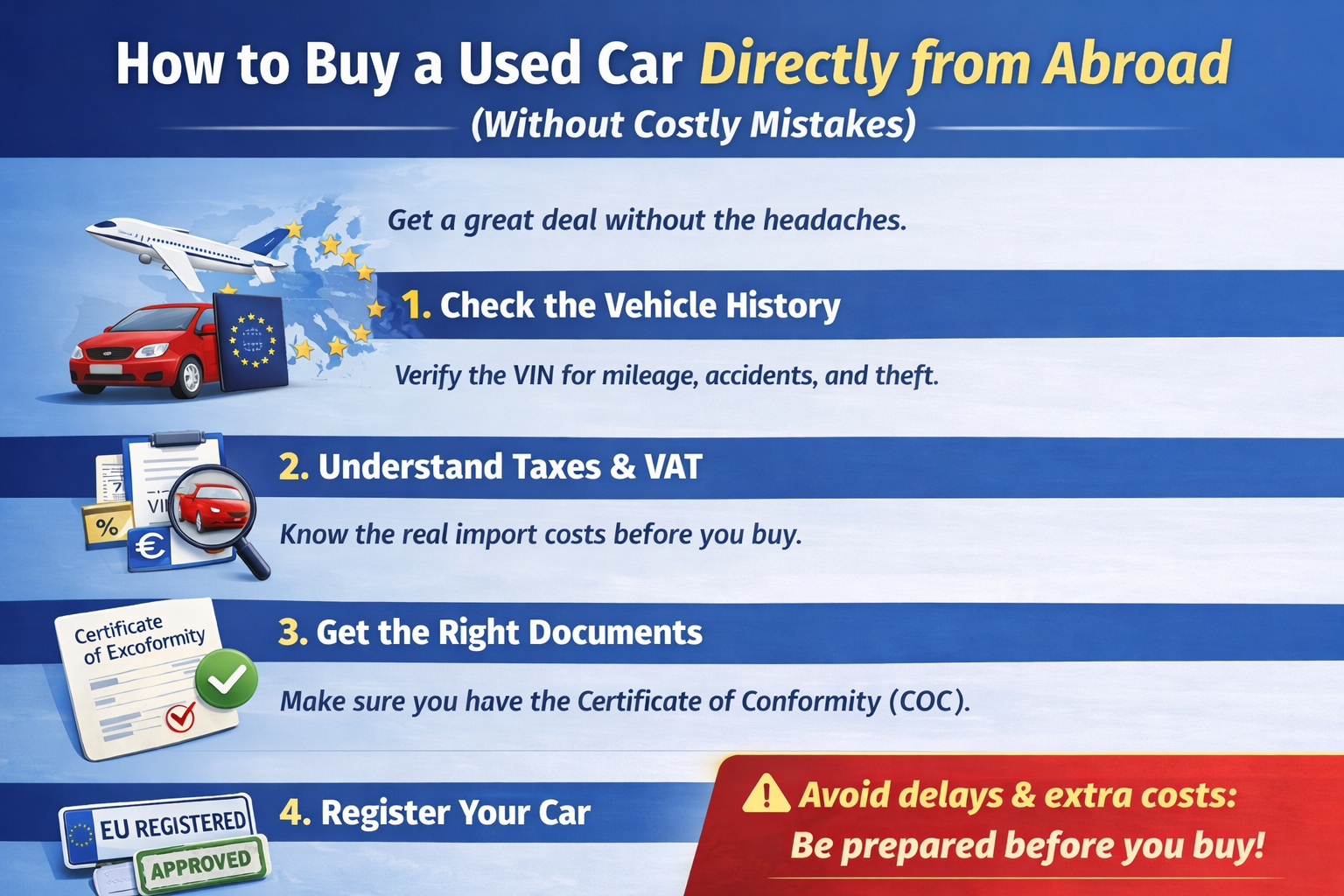
Before you even think about booking a flight or sending a deposit, you should verify the car’s history using the VIN (Vehicle Identification Number).
A proper vehicle history check helps you confirm:
the real mileage
possible accident or damage history
theft records
number of previous owners
whether the car was used as a taxi, rental, or fleet vehicle
Imported cars are statistically more exposed to odometer fraud, simply because they move between countries and databases. A history report is often the only way to spot inconsistencies early and avoid costly surprises later.
One of the most common misunderstandings when buying a car abroad is VAT.
Within the EU, VAT rules depend on:
whether the seller is a private individual or a company
whether the car is considered new or used
the country where VAT was originally paid
In some cases, VAT is already included in the price. In others, you may need to pay VAT again in your home country. Add to this transport costs, temporary plates, insurance, and inspections, and the “cheap car” can quickly become expensive.
Knowing these rules in advance helps you calculate the real total cost, not just the purchase price.
This is where many buyers get stuck.
To register a used car imported from abroad, authorities usually ask for:
the purchase contract or invoice
foreign registration documents
proof of taxes paid
insurance
technical inspection
and often a Certificate of Conformity (COC)
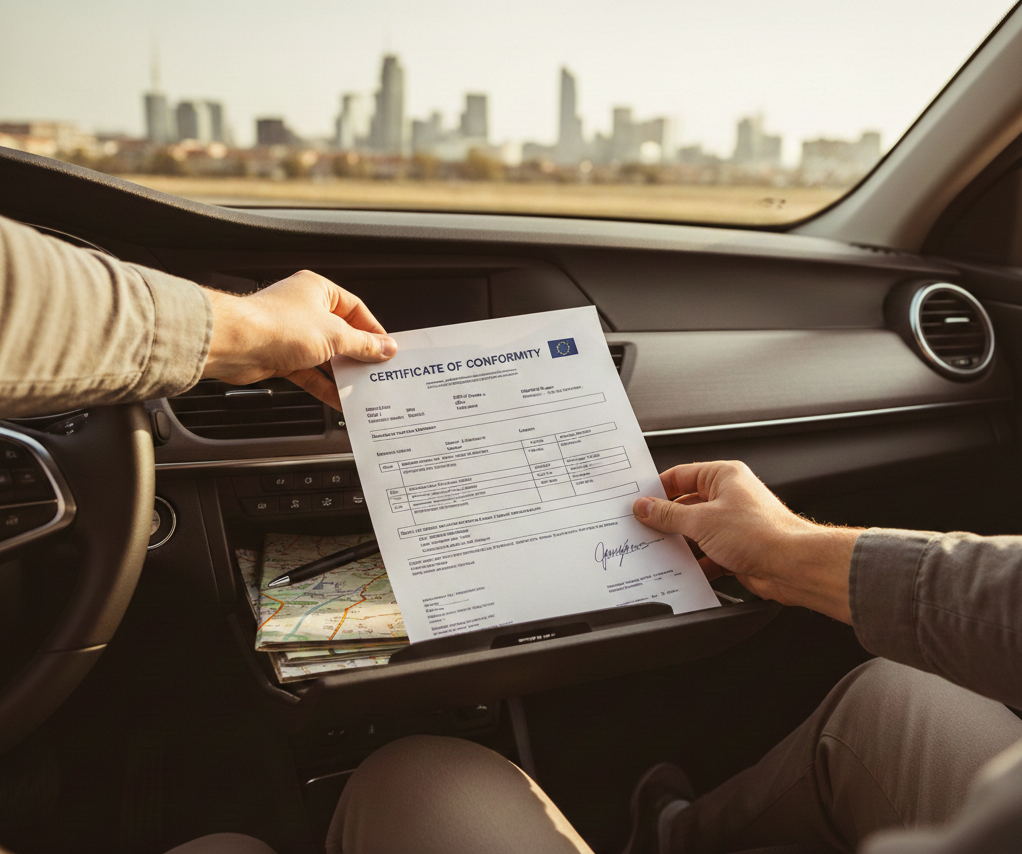
The COC is especially important because it confirms that the vehicle complies with EU technical and environmental standards. Without it, registration may still be possible, but often only after additional inspections, individual approvals, extra costs, and long delays.
In practice, the COC is the document that allows registration offices to process your car quickly and smoothly, without unnecessary complications.
Once the car arrives, registration is the final hurdle.
If all documents are complete and correct, the process is usually straightforward. If something is missing—especially technical data—registration offices may send you to additional inspections or request documents you didn’t expect.
This is why experienced buyers prepare everything before the car crosses the border, not after.
Many problems with imported used cars are not caused by bad luck, but by avoidable mistakes made early in the buying process. Trusting the seller without checking the VIN history, assuming that the Certificate of Conformity automatically comes with the car, or ignoring VAT and tax rules are some of the most common errors buyers make. Others focus only on the purchase price and underestimate the total import cost, including transport, registration, and compliance fees. Starting the registration process without having all required documents often leads to delays, extra inspections, and unexpected expenses. Each of these mistakes can turn a seemingly good deal into a costly and time-consuming experience.
Trusting the seller without checking the VIN history
Assuming the COC “comes automatically with the car”
Ignoring VAT and tax rules
Calculating only the purchase price, not the total import cost
Starting registration without having all required documents
Each of these mistakes can cost time, money, or both.
Buying a used car directly from another country can be a great decision—if you do it right.
Check the vehicle’s history early.
Understand the legal and tax implications.
Make sure you have all registration documents, especially the Certificate of Conformity.
When you approach the process informed and prepared, importing a car becomes a controlled, predictable process instead of a gamble.
If a COC is not available, registration usually depends on national procedures. Common alternatives include national approval based on local rules, individual vehicle approval where the car is tested and inspected in detail, and technical inspections that generate the missing data for the authority. These paths are often more time consuming and can be more expensive than using a COC, but they are sometimes the only option for very old, modified or non EU specification vehicles.
The Certificate of Conformity always comes from the side of the manufacturer, not from a random third party. The key question is who is officially allowed to issue or reissue it for your specific vehicle.
 Manufacturer
The primary source of any COC is the vehicle manufacturer. When a car is produced under EU type approval, the manufacturer creates the technical file and is responsible for the original Certificate of Conformity.
For many new vehicles, the COC is generated at the factory and either handed to the first owner or kept in the brand’s internal systems for later use.
Authorized representative of the manufacturer in the EU
Some brands do not manage all COC requests directly. Instead, they appoint an authorized representative or a dedicated office inside the EU to handle certificates on their behalf. This representative has the legal right to issue COCs for specific VIN numbers, and their name and address can appear on the document. From the point of view of registration authorities, this is still an official and fully valid COC.
Role of intermediary services such as Auto-coc.eu
Services like Auto-coc.eu do not invent their own certificates or rewrite data. Our role is to work between you and the official issuer. We know where to request a COC for each brand, what information is needed, how to avoid mistakes and how to arrange secure delivery. This saves you from dealing with multiple manufacturer portals, language barriers and unclear procedures, while still receiving an authentic, manufacturer based document. See all our available certificates here.
It is important to distinguish between a real COC and a simple “data sheet” or technical summary created by a private company. An authentic Certificate of Conformity is linked to EU type approval and issued in the name of the manufacturer or its authorized representative. Non official documents may look similar but are not recognized in the same way by registration authorities. When registering or importing a vehicle, always make sure you are using a genuine COC, not just a technical information printout.
In recent years, more manufacturers and issuers have started to provide digital versions of the Certificate of Conformity, usually in PDF format. This can be very practical for quick checks and for sending documents to authorities by email. In some cases, a PDF is delivered first so you can prepare your file while the paper original is still on its way by courier.
A digital COC is typically sent as a PDF to your email once the document has been created. It contains the same technical information as the paper version and is often used for online pre registration, document checks or as a backup copy. On auto-coc.eu you can choose of you want to order a PDF COC or want it mailed to you. If you choose the mail option, we will still send you a PDF copy of your COC, via email, in 2-3 business days. This way, if you live in an EU country that accepts PDFs, you do not have to wait for the physical envelope to start your procedures.
Despite digitalisation, many registration offices still want to see the paper original of the COC, especially for first registration or import. Some authorities accept a PDF for initial processing but ask for the original at the final appointment. For this reason, most manufacturers continue to issue a physical document, often with security features such as watermarks, stamps or special paper. If you are unsure, it is safer to assume that the original will be requested.

The price of a Certificate of Conformity is not fixed at EU level. Each manufacturer sets its own fee, and prices can vary quite a lot. For some brands, a COC for a recent passenger car can be relatively affordable, while for others, especially premium or older models, the cost is noticeably higher. The complexity of the internal process, the time needed to check archives and the policy of the brand all influence the final amount.
In broad terms, COC prices usually fall into a range from moderate to quite high, depending on the brand and vehicle type. Some volume manufacturers keep fees closer to the lower end for standard passenger cars, while luxury brands and less common models can be significantly more expensive. Motorbikes, light commercial vehicles or very old models may also sit at a different price level.
Manufacturers charge their own base fee for issuing or reissuing a COC. Intermediaries then add their service margin on top of that, to cover customer support, processing of requests, payment handling and logistics. This is why two services can offer the same authentic COC at slightly different prices. The total you pay reflects both the manufacturer’s cost and how efficient or automated the intermediary is.
It is important to remember that the COC is only one part of the total cost of registering a vehicle. Registration authorities may charge separate fees for issuing the new registration certificate, license plates, road tax, environmental tax or technical inspection. In some countries, the emission values listed in the COC directly influence how much tax you pay, which makes the document even more relevant financially.
Some signs should make you stop and double check the origin of your COC:
The manufacturer name is missing or written incorrectly.
There is no EU type approval number, only vague technical info.
The document is presented as “equivalent to a COC” or a “technical data sheet”, not a real Certificate of Conformity.
The price is far below what most other providers charge for the same brand.
The layout looks improvised, with inconsistent fonts, spelling mistakes or missing signatures and stamps where you would expect them.
The issuer cannot clearly explain whether the document comes from the manufacturer or an authorized representative.
When in doubt, you can contact the registration authority or the official brand representative to ask whether the document you have will be accepted.
A Certificate of Conformity is not in every case, but it is often the most efficient way to register a vehicle that comes from another EU country. Some authorities can use national approvals or invite you to an individual inspection instead, but that route is usually slower and can be more expensive. In many cross border situations the COC is not just helpful, it is practically expected.
Sometimes, but this is the exception, not the rule. A new car sold in the EU may come with a COC included in the purchase, or the manufacturer might issue it once at no cost. For used vehicles, older cars or replacements of lost documents, most brands charge a fee. Intermediary services add their own service margin on top of the manufacturer price.
A COC does not normally expire. It describes how the vehicle was built at the time of manufacture and confirms that it matched an EU type approval then. As long as the car has not been heavily modified and the data still matches, the same COC can be used years later. What can change are rules on taxes, emissions or access to certain zones, but the document itself remains valid.
Yes. The COC is an EU level document. You can use the same certificate to register the vehicle in different EU or EEA countries, provided the car is otherwise in order. However, authorities will not hand the original back to you in every case, so it is wise to keep good copies and only submit the original when you are sure it will not be retained permanently.
If the VIN, engine data, masses or other key fields on the COC do not match the vehicle, the registration office may refuse the document or ask for clarification. Sometimes it is a simple admin error that the issuer can correct. In other cases, it may indicate that the car has been modified or incorrectly described in the past. If you see a discrepancy, contact the issuer before presenting the COC to the authorities, and be prepared for additional checks if the difference is significant.


Using this checklist reduces the risk of surprises and helps you move from purchase to registration with fewer delays and less stress.
Confirm the VIN on the car matches the VIN in the documents.
Ask whether a COC exists and if the seller still has the original.
Verify that the vehicle was built for the EU market, especially for imports from outside Europe.
Check that the car has not been heavily modified in ways that could affect approval.
Do you have the original COC or any manufacturer documents that came with the car
Can you provide a copy of the current registration certificate and inspection reports
Was the car ever refused registration or subject to unusual technical remarks
Has the vehicle been tuned, converted or structurally modified
If the seller cannot provide a valid COC, plan to order it as soon as you decide to buy the car.
Do not wait until the last minute before your registration appointment, because processing and delivery both take time.
For relocations, order the COC shortly after you know you will register the car in a new country, so it arrives before any legal deadline for re registration.
Original COC or official duplicate.
Foreign registration certificate or previous national logbook.
Proof of identity and proof of address, as required by the country.
Proof of purchase or invoice and, if applicable, customs or tax documents.
Technical inspection report if one was performed recently.


Navigating different manufacturer portals, languages and local rules can turn a simple COC request into a time sink. AutoCOC.eu centralises this process so you do not have to start from zero with every brand or authority.
What part of the process Auto-coc.eu handles
We identify the correct issuing source for your brand and vehicle type
We verify that a COC can be issued for your VIN before the request goes forward
We submit the application with the right data and documents
We manage payment, communication and follow up with the issuer
We arrange standard or express delivery through trusted couriers such as FedEx or UPS
We provide clear information on expected processing and delivery times
AutoCOC.eu cannot replace your local authority, but it can prepare you for it. You are responsible for: bringing the COC and other required documents to the registration office, booking any necessary appointments or inspections, paying local taxes, registration fees and plates and following specific national rules on deadlines and procedures
With the COC already in hand, these steps are usually much more straightforward.
AutoCOC.eu supplies authentic Certificates of Conformity issued by manufacturers We guarantee: that you receive a genuine COC, not a non official data sheet, that all information on the document comes from official sources, transparent pricing and clear indication of delivery options.
However, there are limits. We cannot force a manufacturer to issue a COC for vehicles that are not eligible; nor can we guarantee approval in cases where the vehicle is heavily modified, non EU specification or has legal issues in its history. In such cases, we inform you about the situation and, where possible, point you toward alternative options such as individual approval.
If you are unsure whether your vehicle can receive a COC or you need help choosing the right option, you can contact the Auto-coc.eu support team here before ordering. We provide non-stop assistance by email and, where available, through messaging channels listed on the site.
Share your VIN, country of registration and a short description of your case and we will tell you what is realistically possible, what it will cost and how long it is likely to take, so you can make an informed decision before you start.
