

Written by
I. Constantin

Date released
07.05.2026
Comments
0 so far - be the first!
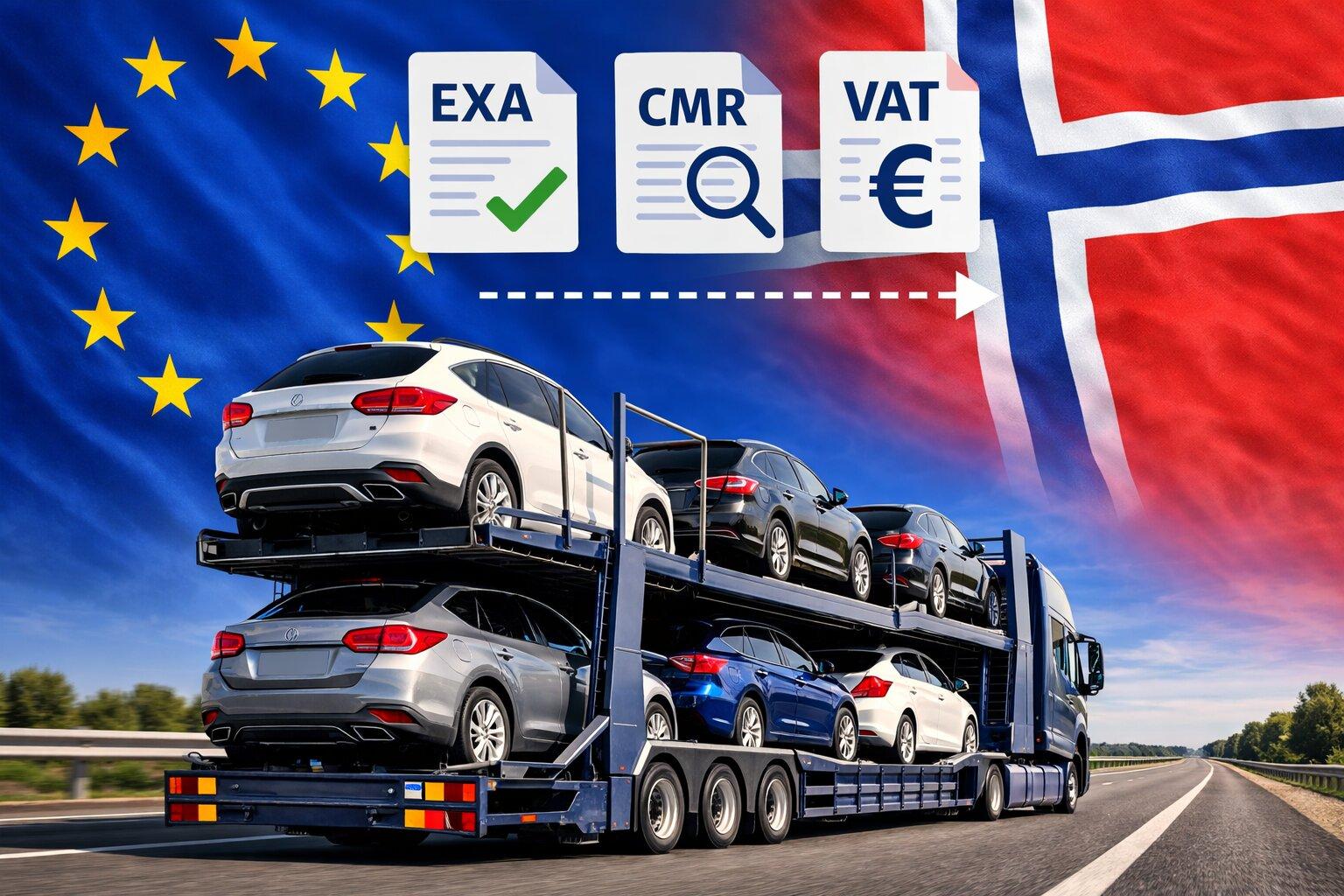
Norway occupies a uniquely confusing position in European automotive law. It is not a member of the European Union, which leads many people to assume that importing a car from Norway is similar to importing from the UK, the US, or Japan.
Norway is a member of the European Economic Area (EEA) and a signatory to the Agreement on the European Economic Area, which means it applies the vast majority of EU single market rules, including EU vehicle type approval regulations. A car registered in Norway that was originally built for the European market is, in most cases, fully eligible for a COC. And that single fact changes the entire import and registration calculation.
This guide explains exactly how Norway’s EEA status affects the COC question, when a COC is and is not available for a Norwegian-registered car, what documents the seller must provide, and what the complete import and registration process looks like in 2026.
The starting point for understanding COC eligibility is Norway’s regulatory framework. As an EEA member, Norway applies EU type approval regulations, which means vehicles sold and registered in Norway that were built for the European market carry valid EU type approvals — the same approvals that govern vehicle sales across all 27 EU member states.
This is fundamentally different from the situation with UK imports post-Brexit or with imports from Japan, the United States, or other non-EEA countries. Those countries operate under entirely separate homologation frameworks. Norway does not.
The COC is valid in all EU member states and EFTA countries — the European Free Trade Association — including Iceland, Liechtenstein, Norway, and Switzerland. This cuts both ways: Norwegian-registered EU-spec vehicles can receive a COC, and that COC is valid for registration across all EU member states.
Because these vehicles meet EU standards, the import process does not require individual vehicle approval. You are not starting from scratch with a non-compliant vehicle; you are dealing with an EU-spec machine registered outside the union.
The COC question for Norwegian imports comes down to one essential criterion: was the vehicle built for and type-approved under EU/EEA regulations?
COC is available when:
The vehicle was manufactured for the European market and carries a EU type approval number. This applies to the vast majority of mainstream passenger cars sold in Norway: Volkswagen, Toyota, BMW, Volvo, Mercedes-Benz, Audi, Ford, Hyundai, Kia, Renault, and all other major brands whose Norwegian market vehicles are identical to — or technically equivalent to — their EU-market equivalents.
You can confirm eligibility by checking the vehicle’s compliance plate, typically located on the door jamb or under the bonnet. An EU type approval reference — formatted as e followed by a number and type approval code — confirms that the vehicle falls within EU type approval and a COC is obtainable.
COC is not available when:
The COC is available only for vehicles produced for the European market. If a vehicle was originally imported into Norway from Japan, the United States, or another non-EU/EEA country — and was registered in Norway under a Norwegian national approval rather than EU type approval — no EU COC can be issued for it. This situation is less common on the Norwegian market than on some others, but it does exist, particularly for certain Japanese domestic market vehicles that were privately imported and registered in Norway.
A second category where the COC may not be available is very old vehicles — vehicles produced and/or registered before 1996 do not have a COC or EEC certificate. For these, historic vehicle registration procedures apply.


Norway drives on the right, like mainland Europe. This is important because it means Norwegian-registered vehicles are configured for right-hand traffic — headlights that dip to the right, standard EU-format lighting — which eliminates the headlight compliance problem that affects UK imports.
However, when a COC states the vehicle can be registered only in countries using left-hand traffic, it is possible that single vehicle approval will be needed. When COC states the vehicle can be registered without any further modifications in countries using right-hand traffic, the COC should be sufficient.
For the vast majority of Norwegian-registered vehicles, the COC will specify right-hand traffic compatibility, meaning no modifications are required for registration in EU member states. This is another significant advantage of Norwegian imports over UK imports, where headlight adaptation is almost always necessary.

When purchasing a car in Norway for export to an EU country, the seller must provide a specific set of documents. Understanding these requirements before the purchase is completed prevents delays and complications at both the Norwegian export end and the EU registration end.
While ownership is managed online, the seller must provide a confirmation of deregistration for export. Without this proof that the vehicle is no longer registered in Norway, EU destination countries cannot finalize the registration process.
A written contract including purchase price, buyer/seller details, and the VIN is essential. This serves as critical evidence for customs clearance and as legal proof of ownership during EU registration.
The Norwegian Tax Administration uses the COC for technical data. EU authorities will require the same; obtaining it before export is significantly easier than retrieving it once the vehicle is abroad.
Depending on your specific destination country within the EU, you may need a formal export declaration confirming the vehicle has legally exited the Norwegian jurisdiction.
While Norway’s EEA membership aligns its vehicle regulations with EU standards, it is not part of the EU Customs Union. Norway is a member of the European Economic Area, meaning it follows certain EU trade regulations but has its own customs and VAT system.
For someone buying a car in Norway to export to the EU, this distinction matters in one direction only: when the vehicle leaves Norway, it must be properly deregistered and, depending on the vehicle’s history in Norway, Norwegian VAT may have implications for the export transaction.
For EU buyers importing from Norway:
The good news is that the EU does not impose customs duties on vehicles imported from Norway. Under the EEA Agreement and associated trade arrangements, passenger vehicles originating in EEA countries enter the EU without customs tariffs. This is a meaningful difference from post-Brexit UK imports, which face the standard 6.5% EU customs duty unless they qualify under rules of origin provisions.
VAT treatment follows the standard EU intra-community rules for imports from EEA countries: if the vehicle is second-hand and purchased from a private individual in Norway, no VAT is due in the EU on import. If purchased from a Norwegian dealer, the VAT treatment depends on whether the dealer operates under the standard regime or the margin scheme. For new vehicles — under 6,000 km or less than six months from first registration — VAT is due in the EU destination country at the local rate.

Once you have the vehicle, the deregistration confirmation from Norway, the COC, and the purchase documentation, the registration process in the destination EU country follows the standard import registration procedure.
Step 1: Obtain the COC before departure. The easiest time to request a missing or replacement COC is before the vehicle leaves Norway. Once you are in your home country and the vehicle is there without a COC, the process of contacting the manufacturer or retrieval service becomes more logistically complex. Request the COC as part of the purchase transaction. If it is not available from the seller, use auto-coc.eu to obtain a replacement before the vehicle moves.
Step 2: Arrange deregistration in Norway. The seller must formally deregister the vehicle from the Norwegian registration system and provide you with documentation of that deregistration. As from 1 January 2026, a registration card (form NA-0221) is no longer issued upon customs clearance in Norway, so the documentation format has changed slightly — confirm with the seller what the current deregistration confirmation looks like under the 2026 rules.
Step 3: Transport the vehicle to the EU. You can drive the vehicle on Norwegian plates for a limited period after customs clearance in Norway. You can drive with foreign number plates for up to 30 days after the vehicle was customs cleared in Norway, provided you have valid number plates, vehicle registration certificate, and insurance. Ensure your insurance covers the transit period and the destination country.
Step 4: Technical inspection in the destination country. Present the vehicle for the national technical inspection (ITV in Spain, ITP in Romania, TÜV or equivalent in Germany, Contrôle Technique in France). With a valid EU-spec COC confirming right-hand traffic configuration, the inspection should proceed without complications related to lighting or technical compliance.
Step 5: Pay any applicable registration taxes. Most EU countries levy a registration tax based on the vehicle’s CO₂ emissions. The COC provides the emissions data needed for accurate tax calculation. Without a COC, the tax calculation may be delayed or require additional assessment.
Step 6: Register at the national road authority. Submit the complete documentation package — COC, deregistration confirmation from Norway, purchase contract, proof of identity, technical inspection certificate, and proof of registration tax payment — to the national registration authority in the destination country.
Official, manufacturer-issued certificates for 90+ brands.
Express delivery available — PDF sent immediately upon processing.
Browse All COCs →Beyond the regulatory framework, Norway offers some practical advantages as a source market for EU car buyers that are worth noting.
Well-maintained vehicles. Norway’s combination of high vehicle standards, mandatory technical inspection, and a car-conscious population tends to produce well-maintained second-hand vehicles with verifiable service histories.
Strong EV market. Norway has, by a significant margin, the highest electric vehicle penetration rate in the world. Norwegian-registered EVs are EU-spec vehicles eligible for COCs and, in many EU countries, benefit from reduced or zero registration taxes. For EU buyers interested in importing a used EV, Norway is one of the most interesting source markets in Europe.
No right-hand drive complications. Unlike the UK, every Norwegian-registered vehicle is left-hand drive and configured for right-hand traffic — eliminating the headlight adaptation costs and compliance complications that add expense and uncertainty to UK imports.
Transparent vehicle history. Norway’s digital vehicle registration and inspection system provides a clear and verifiable history for most registered vehicles, reducing the risk of odometer fraud or undisclosed damage. Supplement this with a VIN check through auto-coc.eu/check-your-vin/ to confirm the vehicle’s history across multiple countries before purchase.
Enter your VIN, select your brand, and choose standard or express delivery.
Best price guaranteed · EU-compliant · Multilingual support


