News & Guides /
COC vs CE Certificate: What’s the Difference (and Which One Your Car Actually Needs)
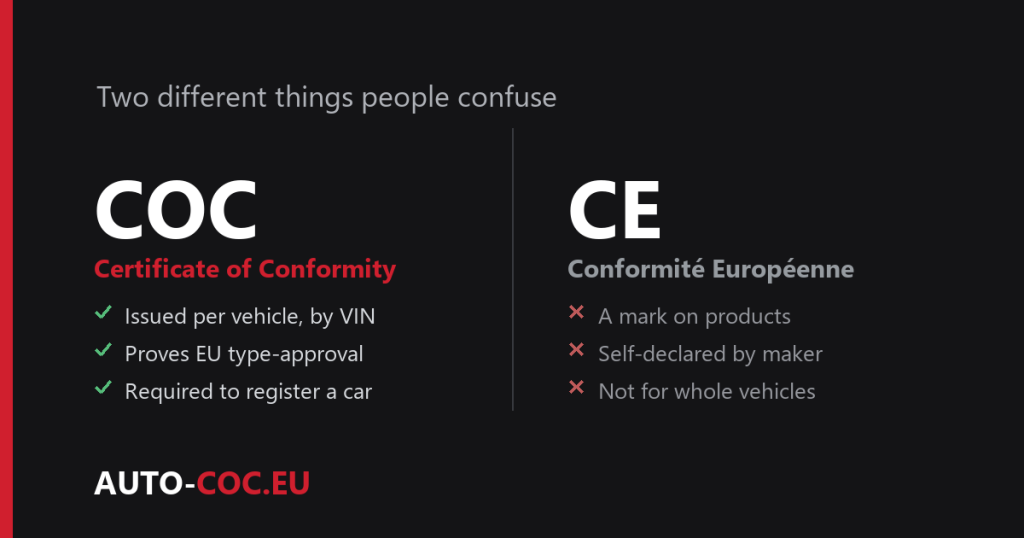
You bought a car in another EU country. The registration office asked for a “certificate of conformity”. Somewhere between the seller’s email and your third Google search, you landed on pages about CE marking — toys, phone chargers, industrial machines, a two-letter logo printed on the back of a laptop. Now you’re not sure whether you need a COC, a CE certificate, or both.
Here is the short version of the COC vs CE certificate question: they are two different systems, and only one of them has anything to do with registering your car. A COC is a document issued by the vehicle manufacturer for your specific car, identified by its VIN. CE marking is something a manufacturer puts on certain products — and a complete motor vehicle is not one of them.
This article sorts out which document belongs to which situation, why the two terms sound so similar, and what to do if your paperwork mentions “CE” somewhere and you’re now second-guessing yourself.
COC vs CE certificate: the short answer
A Certificate of Conformity (COC) is issued by the vehicle manufacturer for one individual vehicle. Under Article 36 of Regulation (EU) 2018/858, the manufacturer issues a certificate of conformity for each vehicle made available on the market, it accompanies the vehicle, and it is delivered to the buyer free of charge together with the car. The same Regulation, in Article 48, ties registration to it: vehicles subject to whole-vehicle type-approval may only be made available on the market, registered or entered into service if they are accompanied by a valid certificate of conformity issued in accordance with Articles 36 and 37.
That is the document your registration office wants.
CE marking works on a completely different track. Regulation (EC) No 765/2008 defines it as a marking by which the manufacturer indicates that the product conforms to the applicable requirements set out in the EU harmonisation legislation providing for its affixing. Article 30 of the same Regulation adds the rule that most people never hear: the CE marking may only be affixed to products for which specific Union harmonisation legislation provides for it, and shall not be affixed to any other product. Behind the mark sits a document called the EU Declaration of Conformity, whose model structure comes from Annex III of Decision No 768/2008/EC.
So a “CE certificate for a car” is not a document you’re missing. In the sense people usually mean it, it does not exist — complete vehicles run through the EU type-approval system instead, and their per-vehicle paper is the COC.
COC vs CE certificate side by side
| Certificate of Conformity (COC) | CE marking / EU Declaration of Conformity | |
|---|---|---|
| What it is | A document describing one individual vehicle and confirming it matches an approved vehicle type | A marking affixed to a product, backed by a declaration signed by the product’s manufacturer |
| Who issues it | The vehicle manufacturer (Mercedes, VW, Renault…), for a specific VIN | The product manufacturer or its authorised representative — no outside body issues the mark itself |
| What it applies to | Motor vehicles, trailers and their systems/components under EU vehicle approval rules | Products covered by EU harmonisation legislation that requires the mark: electronics, toys, machinery, PPE, medical devices and many more |
| EU legal basis | Regulation (EU) 2018/858, in force since 1 September 2020 (it repealed Directive 2007/46/EC); document template set by Commission Implementing Regulation (EU) 2020/683 | Regulation (EC) No 765/2008 (definition and general principles) plus the specific product legislation; declaration model in Decision No 768/2008/EC |
| Needed to register a car? | Yes — required for registration under Article 48 of Regulation (EU) 2018/858 | No. No EU registration office asks for a CE mark or a CE declaration for a car |
| Where you find it | In the car’s document folder if it was kept; otherwise ordered again from the manufacturer or an authorised provider using the VIN | Printed on the product or its rating plate; the declaration comes with the product or from the seller’s website |
One column deserves a second look: who issues it. A COC comes out of the manufacturer’s database and nobody else can create one legally. A CE mark is affixed by the product manufacturer on its own responsibility. Different logic, different paperwork, different world.
Which one do you need?
Match your situation to the list below. It covers nearly every case that reaches our inbox.
You are registering a car, van, motorcycle or motorhome in an EU country → you need a COC.
The registration office will ask for the certificate of conformity, not a CE document. If the car came with a folder from the first owner, check it — the original may already be there. If not, a copy can be re-issued from the manufacturer’s records using the VIN. Our full guide to the Certificate of Conformity walks through the procedure, the costs and the timelines.
You bought a product — a bike carrier, a dashcam, an EV charging cable, a child seat → CE is the relevant framework, not COC.
The product’s manufacturer handles it. You don’t order anything, you don’t apply for anything. If you need the EU Declaration of Conformity (for insurance or a warranty claim, for instance), ask the seller or the manufacturer — they must be able to produce it for products covered by legislation that requires the mark.
You are importing a car that was not built for the European market → neither document solves it on its own.
A car built to US or Japanese standards was never type-approved in the EU, so no COC exists for it, and a CE mark would be equally irrelevant. That case goes through national individual approval. We covered the routes and the pitfalls in the guide for cars not originally made for the EU market.
You are registering a trailer or a caravan → COC, same as a car.
Trailers fall under the same vehicle approval framework. The manufacturer of the trailer issues the certificate, and the registration office treats it exactly like a car’s COC.
Someone offered you a “CE certificate” for your car for under €70 → walk away.
This is the one situation where the terminology confusion turns into money lost. There is no such product for a complete vehicle. What arrives is usually a PDF with your VIN typed into a template, which registration offices reject on sight. Our article on how to spot a fake COC document lists the warning signs.
Where the confusion comes from: “EC certificate of conformity”, CE marking, and everything in between
The COC vs CE certificate mix-up is not carelessness on the reader’s side. Three separate things collided.
1. The old legal term was “EC certificate of conformity”. Before the current rules, the framework was Directive 2007/46/EC, and the vehicle document was widely written as the “EC certificate of conformity” — EC for European Community. Read quickly, or translated loosely into another language, “EC” turns into “CE”. Regulation (EU) 2018/858 repealed that Directive and has applied since 1 September 2020, and the current term is simply “certificate of conformity”. Older forum posts, dealer emails and even some official templates still carry the old wording.
2. “European Certificate of Conformity” is everyday shorthand for the COC. Providers, dealers and registration clerks all use it. It has nothing to do with CE marking, but it does put the words “European” and “conformity” next to each other, which is enough to send a search in the wrong direction.
3. “Certificate” and “declaration” are not the same document. In the product world, the manufacturer signs an EU Declaration of Conformity and affixes the CE mark — no certificate is issued to the buyer for most product categories. In the vehicle world, the manufacturer issues a certificate, per vehicle, tied to the VIN. People search for “certificate of conformity” and get results from both worlds, written by consultants who mean industrial products, not cars.
Add a fourth ingredient: your car does carry conformity marks, just not CE ones. That’s the next section.
The marks on your car and its parts: e, E and CE decoded
Look at your registration certificate, field K. You’ll find a type-approval number that usually starts with a lowercase e followed by a country number — e1 for Germany, e2 for France, e9 for Spain, and so on. That’s the EU type-approval marking, the sign that your vehicle model was approved for the European market. It is what makes a COC possible for your VIN in the first place.
Then there’s the uppercase E in a circle, followed by a number. That’s a type-approval granted under a UN Regulation by an authority of a country party to the 1958 Agreement — for example UN Regulation No 10, which covers electromagnetic compatibility for vehicles and their electrical sub-assemblies. You’ll see it on lighting units, tow bars, aftermarket alarms and in-car electronics.
And CE is the third one, from an entirely different legal family: it is a self-declaration by the product’s manufacturer under EU product legislation, not an approval granted by a national or UN authority.
| Mark | Where you see it | What it means | Do you need it for registration? |
|---|---|---|---|
| lowercase e + number | Registration certificate field K, vehicle plates | EU type-approval of the vehicle type | Indirectly — it’s why your car has a COC |
| uppercase E in a circle | Lights, tow bars, car electronics, aftermarket parts | UN type-approval (1958 Agreement, e.g. UN Reg. No 10) | Relevant if you modify the car, not for a standard registration |
| CE | Consumer and industrial products | Manufacturer’s declaration under EU product legislation | No |
If someone tells you your car “needs CE certification” before it can be registered, they are describing a requirement that does not exist in the vehicle approval framework.
What a COC actually contains
The certificate of conformity is a standardised form. Its content and layout follow Commission Implementing Regulation (EU) 2020/683, and Regulation (EU) 2018/858 requires the paper certificate to be designed in a way that prevents forgery — which is why originals carry security features that a scanned copy doesn’t reproduce.
On the document you’ll find the VIN, the make and commercial name, the type-approval number, the vehicle category, masses and dimensions, engine and emissions data, CO₂ figures, fuel consumption, sound levels, seating capacity, tyre and axle data. It is, in effect, the factory’s technical identity card for your exact car — which is why registration offices use it instead of asking you to prove each figure separately.
Two practical consequences follow.
First, a new car’s COC is free. Article 36 states the certificate is delivered free of charge to the buyer together with the vehicle, and its delivery may not be made conditional on an explicit request. If you bought a car new and never received it, ask the selling dealer — you were entitled to it.
Second, a replacement copy for a used import is a different matter. The manufacturer charges to retrieve and re-issue the document years later, and that’s the cost you see quoted online. Prices differ by brand because the manufacturers’ fees differ, not because the paper is different. Our page on what a COC is covers the basics if you want the shorter version.
Frequently asked questions
Is a COC the same as a CE certificate?
No. A COC is a per-vehicle document issued by the car manufacturer under Regulation (EU) 2018/858 and required for registration. CE marking is a product marking under EU product legislation, affixed by the product’s manufacturer. Different rules, different documents, different purposes.
What is an “EC Certificate of Conformity” — is it different from a COC or a CE certificate?
“EC certificate of conformity” is the older term for the same vehicle document, from the days of Directive 2007/46/EC. It means COC. The “EC” stands for European Community, not for CE marking. Since 1 September 2020 the applicable framework is Regulation (EU) 2018/858 and the document is simply called the certificate of conformity.
Do cars need CE marking to be registered in the EU?
No. Complete vehicles are covered by the EU type-approval system, and Regulation (EC) No 765/2008 is explicit that the CE marking is only affixed to products for which specific EU harmonisation legislation provides for it. Registration requires the certificate of conformity, not a CE mark.
What is the difference between CE marking and an EU Declaration of Conformity?
The CE marking is the visible sign on the product. The EU Declaration of Conformity is the signed document behind it, in which the manufacturer states which legislation the product complies with; its model structure comes from Annex III of Decision No 768/2008/EC. Neither replaces a COC for a vehicle.
Can I register my car with a CE certificate instead of a COC?
No. Registration offices check the certificate of conformity against the manufacturer’s data. Any document presented as a “CE certificate” for a complete car is either a misunderstanding or, if you paid for it, a scam.
Where do I find my vehicle’s COC number if my documents mention “CE” somewhere?
The COC doesn’t have a “COC number” in the way people expect — the vehicle is identified by its 17-character VIN, and the type-approval number appears in field K of the registration certificate, starting with a lowercase “e”. A “CE” reference in your paperwork usually belongs to an accessory, a retrofitted part or a translated old-format form.
Why does my car’s radio have a CE mark but my car itself doesn’t?
Because the radio is a product in its own right when sold separately, and it falls under EU product legislation — typically the Radio Equipment Directive (2014/53/EU), which requires CE marking on radio equipment placed on the market as a standalone product. Fitted equipment and aftermarket electronics also come under vehicle-specific approval for electromagnetic compatibility (UN Regulation No 10, the circled E mark). Your car as a whole is not a “CE product”; it’s a type-approved vehicle, and its per-vehicle document is the COC.
Start with the VIN, not with the acronym
If you are registering a car in the EU, the document to chase is the certificate of conformity, and the only thing you need in order to check what’s possible is the 17-character VIN.
Run your VIN check before you order anything — it tells you what the car actually is, which is the fastest way to end the COC vs CE certificate confusion for your specific case.
Still unsure whether a COC exists for your vehicle? Send us the VIN through the contact form and we’ll tell you before you pay anything.